
How to Create a Health and Wellness Affiliate Program (2026)
To create an affiliate program for your health and wellness store, you need four things:
- A commission structure your margins can support (usually 10% to 20%)
- A reliable way to track referrals
- Written terms that ban unapproved health claims
- A plan for recruiting partners your customers already trust
If your store runs on WooCommerce, you can have all of this live in an afternoon with an affiliate plugin.
In this guide, we’ll walk through each of those steps, along with the parts that are unique to selling health products, like the advertising rules and what your affiliates are allowed to say about your products on your behalf.
Descargo de responsabilidad: This article is general information for store owners, not legal advice. For the rules that apply to your products and region, check with a qualified lawyer.
Why health and wellness stores do so well with affiliates
The wellness market is enormous. The Global Wellness Institute valued the global wellness economy at $6.8 trillion in 2024 and expects it to approach $9.8 trillion by 2029. For a store owner, though, the more useful fact is how people in this market decide what to buy. They rely on trust.
Nobody buys a supplement, a skincare routine, or a fitness plan from a banner ad. People buy these products because someone they trust said it worked for them: a personal trainer, a nutrition blogger, a friend, or a creator they’ve followed for years. An affiliate program is simply a way to formalize those recommendations and reward the people making them.
Two other traits make this vertical a natural fit:
- Repeat purchases. Supplements, protein, teas, and skincare run out. A single referred customer can reorder for years, which means each affiliate sale is worth far more than its first order value.
- A huge creator ecosystem. Fitness, nutrition, and self-care are among the largest content categories on YouTube, Instagram, and TikTok. Finding potential partners is rarely the problem. The harder part is managing them all, which is where a proper program comes in.
What makes this niche different (read this before you launch)
Health products are regulated in a way that gadgets and t-shirts are not. When an affiliate promotes your products, regulators can hold you responsible for what they say. That has two practical consequences.
A quick note: the summaries below come from published regulator guidance, may not be accurate or up to date, and the details depend on what you sell and where. Sensitive categories deserve proper advice from a specialist.
1. Your affiliates cannot make health claims you can’t back up
In the US, the FTC’s Health Products Compliance Guidance and FDA rules limit what supplement sellers and their marketing partners can claim, and the UK and EU have equivalents through the ASA and the register of authorized health claims. The short version: if you can’t back a claim with real evidence, your affiliates shouldn’t be making it either.
You can’t personally review every TikTok an affiliate posts. What you can do is put clear rules in your affiliate terms, give partners pre-approved product descriptions to work from, and remove anyone who promotes a false claim. More on both below.
2. Affiliates need to disclose the relationship
Advertising rules in most countries expect anyone earning commission to say so clearly (“#ad”, “I earn commission from this code”, or similar). Make disclosure a condition of joining your program rather than a suggestion.
None of this should put you off. These rules apply to every marketing channel you’d use anyway, and putting your rules in writing is most of the work. It just means the “set it and forget it” approach that works for a phone case store is not the right approach here.
Step 1: Set a commission rate your margins can survive
Health and wellness commissions cluster higher than general retail. Supplement and skincare brands commonly pay 10% to 20% per sale, and some direct-to-consumer brands go to 30% or more because the margins on consumables allow it. Pharmacy-style retailers with thin margins sit much lower, often 1% to 4%.

Start from your numbers, not from what competitors advertise. Work out your margin after product cost, shipping, and the discount attached to any affiliate coupon, then decide what share of that you’re willing to give up for a new customer. Because repeat purchases are common in this niche, many stores pay a higher rate on a customer’s first order and rely on reorders coming in commission-free, while others pay a lower rate on every order to keep affiliates promoting long term. Both approaches work; pick the one that matches how often your product gets rebought.
We’ve covered the full calculation, with examples, in our guide to setting affiliate commission rates in WooCommerce.
Step 2: Choose how you’ll track referrals (coupons beat links here)
Most affiliate software tracks referrals with links and browser cookies. That works, but it has a weakness that matters a lot in this niche: wellness content lives on Instagram, TikTok, YouTube, and podcasts, where links are awkward to share and cookies get blocked or expire before people buy.
Coupon-based tracking solves this. Each affiliate gets a unique discount code (SARAH10, COACHMIKE, and so on). When a customer uses the code at checkout, the sale is credited to that affiliate, no matter where they heard about it. A personal trainer can mention their code in conversation and still get paid for the sale. The customer gets a discount as a built-in reason to use it, too. If you want the full reasoning, we’ve written a separate guide on cookieless affiliate marketing with coupons.
The good news is you don’t have to choose only one. The setup below supports coupon codes and referral links together, so bloggers can use links while creators use codes.
Step 3: Set up the program in WooCommerce
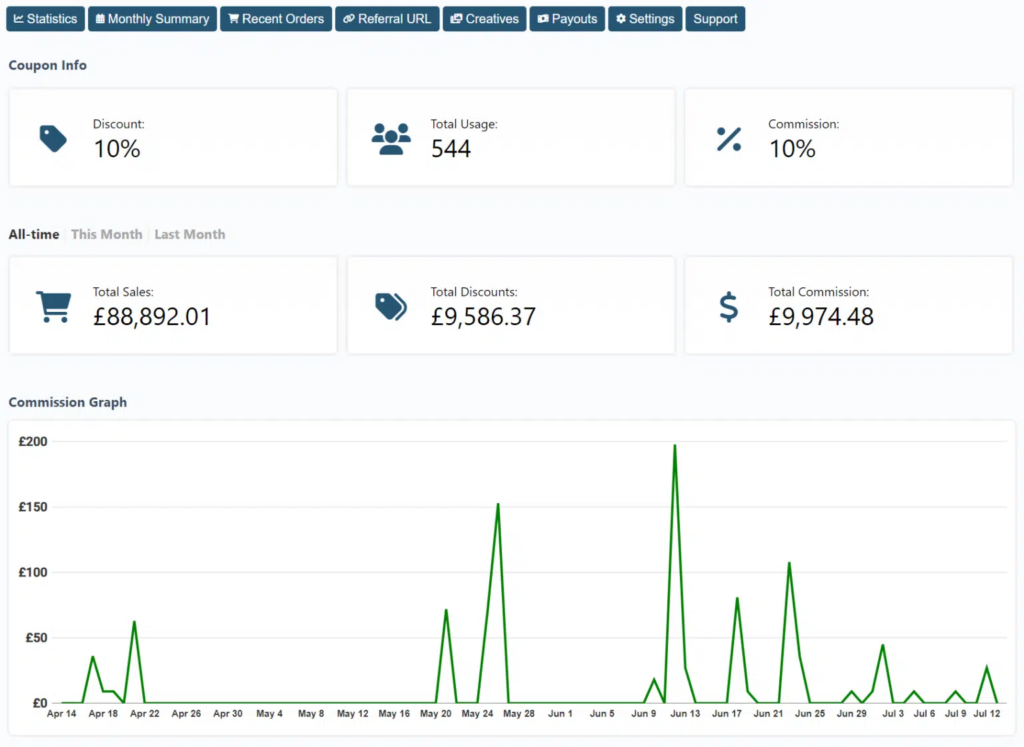
WooCommerce has no affiliate system built in, so you’ll need a plugin. Ours, Afiliados al cupón, is built around exactly the coupon-first approach described above: affiliates register through a form on your site, each one gets a unique coupon and referral URL, and they get a dashboard showing their sales, commission, and payouts. It’s used by over 7,000 stores, and there’s a free version to start with. The honest caveat: it only works with WooCommerce, so if you also need to track referrals for a separate SaaS product or a second store on another platform, a standalone platform will suit you better.
The setup itself takes maybe an hour: install the plugin, create your registration page, set your default commission rate, and configure how coupons are generated for new affiliates. Rather than repeat every click here, follow our step-by-step guide to creating an affiliate program for your WooCommerce store, which covers the whole process with screenshots.
A few settings deserve extra attention for a wellness store:
- Manual affiliate approval. Vet every applicant. Fraud checks matter everywhere, but in this niche you also want to know whether an applicant’s content makes claims you’d be comfortable seeing next to your brand.
- Commission on the discounted total. Pay commission on what the customer actually paid after the coupon, not the pre-discount price. It sounds obvious, but plenty of store owners discover the difference on their first payout run.
- Affiliate groups. A dietitian with a clinic newsletter and a 19-year-old gym TikToker should probably not be on identical terms. Groups let you give different rates and rules to different partner types. Here’s how affiliate groups work.
Step 4: Write terms that cover health claims
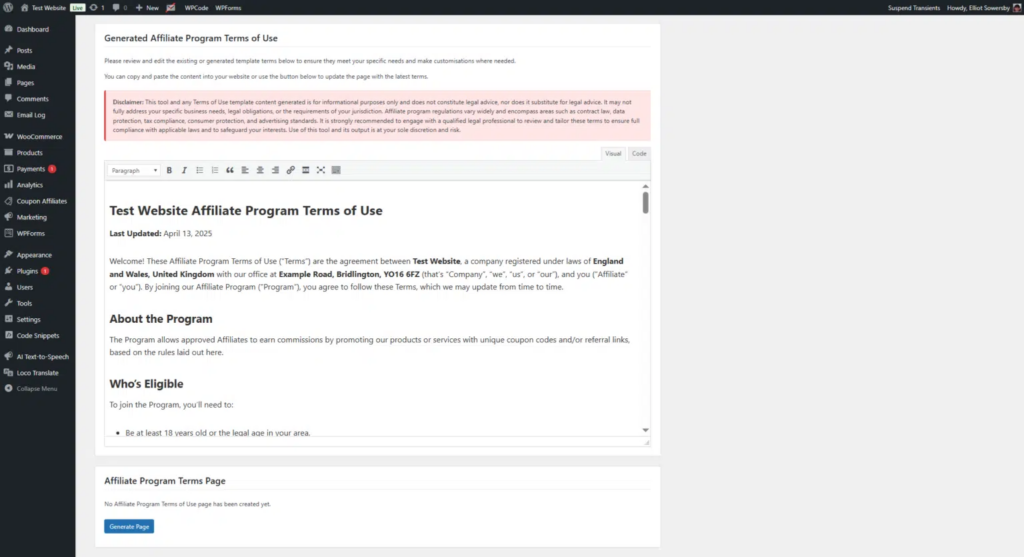
Every affiliate program needs a terms and conditions page. Most health and wellness stores add three clauses that a generic template leaves out:
- A claims clause. Affiliates may only describe products using your approved product descriptions, and make no false claims.
- A disclosure clause. Affiliates agree to clearly disclose that they earn commission, in every format they use.
- A removal clause. You can terminate any affiliate and withhold unpaid commission for violating the rules. This is the clause that gives the others teeth.
Our guide to creating an affiliate terms and conditions page covers the standard clauses (payouts, self-referrals, trademark bidding) that sit alongside these. And as above, if your products sit in a regulated category, it’s worth the small fee to have a lawyer read your finished terms before you publish them.
Step 5: Recruit partners your customers already trust
Recruitment in this niche is less about follower counts and more about credibility. The partners who convert best for wellness stores tend to be:
- Practitioners. Personal trainers, yoga teachers, nutritionists, physios, and massage therapists recommend products to clients face to face. A coupon code fits this perfectly, since there’s no link to click in a conversation.
- Micro-influencers in a tight niche. A creator with 8,000 followers who all care about marathon training will usually outsell a lifestyle account with 300,000. Their audience trusts them, and their rates are reasonable.
- Your own customers. Wellness purchases are personal recommendations waiting to happen. Invite repeat buyers to join the program in your post-purchase emails.
- Bloggers and YouTubers who rank for your products. Anyone already ranking for a keyword is sending customers somewhere. It might as well be to you. Our guide to working with YouTubers goes deeper on this.
When you vet applicants, spend five minutes on their recent content. If they’re currently promoting a “detox tea” with miracle claims, that’s how they’ll promote you. For outreach templates and more recruitment channels, see our guide to recruiting affiliates and the breakdown of the 12 tipos de afiliados you can work with.
Step 6: Give affiliates compliant materials to work with
The easiest way to stop affiliates from inventing claims is to hand them better material than they’d write themselves. Prepare a short pack for every new partner:
- Approved product descriptions with the claims you can actually support
- Product photos and banners in the sizes they’ll need
- A one-line disclosure example they can copy
- Their coupon code and referral link, front and center
You can also generate a dedicated landing page for each affiliate automatically, showing their name, their code, and the discount, so the traffic they send arrives on a page built around their offer. We’ve explained that setup in cómo crear automáticamente páginas de destino para afiliados.
Step 7: Watch for coupon abuse from day one
Every affiliate program attracts a few people who try to earn commission without sending you any customers. The classics are using their own code for personal orders and leaking codes to coupon sites, though a determined abuser will also sign up twice and refer themselves. Wellness stores see plenty of this because discount-hunting on supplements is a sport of its own.
Start by blocking self-referrals in your plugin settings and reviewing any order where the coupon email matches the affiliate email. If a code shows up on websites like RetailMeNot without your permission, deal with it quickly. We’ve written a full guide to preventing coupon abuse and fraud in WooCommerce.
Frequently asked questions
Can I run an affiliate program for a medical or healthcare service website?
Be careful here. Paying for referrals of actual patients to clinics, prescriptions, or medical services can be restricted or outright illegal depending on where you operate. Affiliate programs in the health space are for retail products: supplements, fitness gear, skincare, wellness devices, courses, and similar. If your website sells regulated medical services, talk to a healthcare lawyer before paying anyone for referrals.
What commission rate should a supplement store pay affiliates?
Most supplement brands pay between 10% and 20% per sale. Direct-to-consumer brands with high margins sometimes pay 25% to 40% to win shelf space with big creators, while low-margin retailers pay single digits. Calculate what your margin allows after the coupon discount, then check you can still profit if a referred customer never reorders.
Do my affiliates really have to disclose that they earn commission?
Yes. Advertising regulators in the US, UK, EU, Canada, and Australia all expect clear disclosure of paid partnerships. Write it into your terms and give affiliates a copy-paste disclosure line in their welcome pack so there’s no excuse to skip it.
Should I use coupon codes or referral links for a wellness brand?
Use both, but expect codes to do most of the work. Wellness audiences live on social platforms and hear about products in videos, podcasts, and conversations, where a memorable code travels better than a URL. Links still matter for bloggers and email newsletters, so pick software that tracks both and credits the same affiliate either way.
Final thoughts
Health and wellness is probably the single best vertical for a store-run affiliate program. Purchases are trust-driven, customers reorder, and the supply of creators and practitioners to partner with never runs dry. The extra work compared to other niches mostly comes down to paperwork: vet your partners properly and put your claims and disclosure rules in writing before the first one signs up.
We’re biased about the software, since we make it, but the free version of Afiliados al cupón is a low-risk way to test whether affiliate marketing works for your store. Start with five partners you’d trust to talk about your products at a dinner party, and grow from there.
Disclaimer: nothing in this post is legal advice. Regulations vary by country and product category, so speak to a lawyer who knows your market before relying on anything here for legal decisions.

Elliot Sowersby es un desarrollador de WordPress de Yorkshire, Reino Unido. Es el fundador y desarrollador principal de Afiliados al cupón y RelyWP.


 English
  Spanish
  German
  French
Deja una respuesta