
How to Recruit Affiliates: 11 Ways to Find Good Partners (2026)
The quickest way to recruit affiliates is to start with people who already like what you sell, your customers and the people on your email list. After that, look for affiliate partners who post about your product category.
The bloggers and creators who promote your competitors are the easiest ones to find. Contact them one at a time with a short, personal message and offer to send them the product. Then approve each application by hand. That keeps your codes away from the wrong people.
Below we cover how to recruit affiliates from each of these sources, and how to check applications before you say yes. You’ll also find an affiliate recruitment email template and a plan for your first ten affiliates if you’re starting from zero.
A quick disclosure: we make Coupon Affiliates, an affiliate plugin for WooCommerce, and a few examples below mention its settings. The rest of the advice applies whatever you use to run your program.
Jump to a section:
- Before you start recruiting
- What a good affiliate looks like
- Recruitment strategies at a glance
- Start with people who know your brand
- Finding affiliates in your niche
- Paid and offline recruiting
- Recruitment email template
- How to vet new affiliates
- Recruiting your first 10 affiliates

Before You Start Recruiting
Good affiliates will look at your program before they reply to you. Get these in place first:
- A signup page that says what affiliates earn and how they get paid. Our guide to the affiliate form and signup page has examples.
- A commission rate you can keep paying for years. Cutting it later annoys the people you worked hard to bring in. See how to set affiliate commission rates.
- Written terms covering things like bidding on your brand name in Google Ads and posting codes to coupon sites. Here’s how to write affiliate terms and conditions.
- Somewhere affiliates can check their sales, because people stop promoting when they can’t see what they’ve earned.
If your program isn’t live yet, our WooCommerce affiliate program checklist goes through the full setup.
What a Good Affiliate Looks Like
Most people look at follower count first, but on its own it says very little about sales. A food blogger with a few thousand readers who cook from her recipes every week can easily outsell a lifestyle account with 200,000 followers that posts a different brand every day.
When you’re weighing someone up, these questions are more useful:
- Would the people who follow them buy from your store?
- Does the engagement look real? Comments with actual questions are a good sign. Rows of emoji replies aren’t.
- Do they recommend things they’ve used, and will they admit when something is bad? Someone known for pushing whatever pays can damage your brand’s reputation.
- Do they post about your niche every week, or was it a one-off? Regular posters keep sending sales long after the first mention.
Some of your best affiliates will be past customers. They know the product and can talk about it without a script. For a wider look at who you could invite, from coupon sites to podcasters, see our list of 12 types of affiliates.
Summary of Affiliate Recruitment Strategies
Here are the eleven places we cover below, with a rough idea of the effort each one takes.
| Where to look | Effort | What you usually get |
|---|---|---|
| Your customers | Low | Small audiences, high trust |
| Your website | Very low | A steady trickle of applications |
| Email list and social followers | Low | Fans who engage with you |
| Your existing affiliates | Low once set up | People similar to your best affiliates |
| Niche blogs and review sites | Medium | Search traffic that keeps coming |
| Creators on video and social | Medium to high | Bursts of sales, uneven results |
| Competitors’ affiliates | Medium | Proven sellers who need a reason to switch |
| Brands with the same customers | Medium | Cross-promotion to a matching audience |
| Communities and forums | Medium | Engaged members, strict rules |
| Paid ads | High, plus ad spend | Volume, mixed quality |
| Industry events | High | A few close relationships |
Start With People Who Know Your Brand
Your own customers and followers cost the least to recruit, and they tend to stick around longer than people you approach cold.
1. Turn happy customers into affiliates
For most online stores, customers make the best affiliates. They’ve paid for the product themselves. Friends and family take their word for it, and you don’t have to explain what it does.
Ask when they’re most pleased with you:
- In a follow-up email a few days after their order arrives
- When you thank them for a good review
- After a support ticket ends well
- On their account page, as a small “Earn with us” link
Make sure they’re actually happy first. Someone still waiting on a refund won’t take the invite well.
With Coupon Affiliates PRO you can also create an affiliate application for every new customer account automatically. Those applications still wait for your approval, unless you’ve turned on auto-accept too. We’d think twice before using both together, since it means every new customer gets a live coupon code on your store.

2. Make your program easy to find on your site
Plenty of stores have an affiliate program that nobody can find. At the very least, link to your signup page in the footer. If creators matter to your business, put the link in the main menu as well, or show it on the order confirmation page.
A clear affiliate page can also rank in Google for searches like “[your brand] affiliate program”, and that’s how a lot of creators look for programs to join.
3. Tell your email list and social followers
Your subscribers and followers chose to hear from you, which makes them an easy audience to pitch. Send one email that’s only about the affiliate program, then keep a single line about it in your newsletter footer.
On social media, mention it more than once. A pinned post or a Story highlight keeps it visible for anyone who missed the first announcement. Say what the commission is and include the signup link. A vague “we have an affiliate program!” post gives nobody a reason to click.
4. Get your affiliates to bring in more affiliates
Once a few of your affiliates are doing well, they can be your best recruiters. They know other creators in the same space and can tell them honestly what it’s like to work with you.
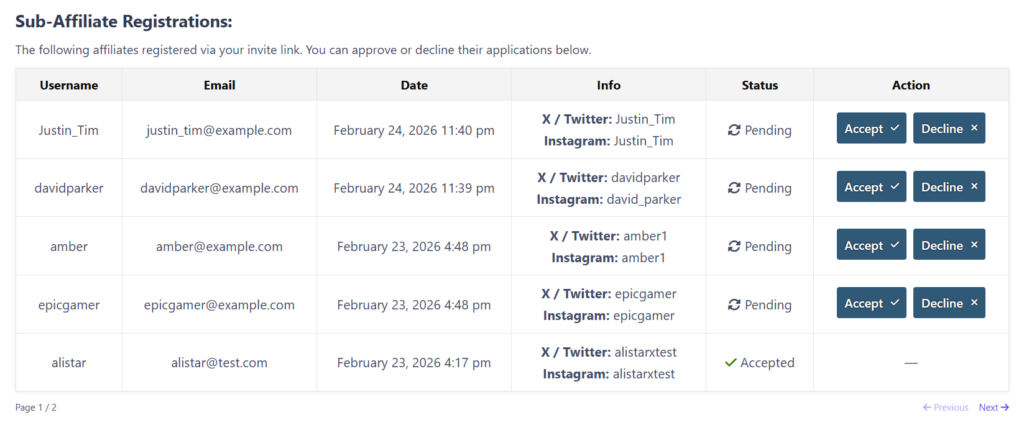
A multi-level (sub-affiliate) setup pays them a small extra commission on sales from anyone they bring in. In Coupon Affiliates this is the Multi-Level Affiliates module, part of PRO. Each affiliate gets an invite link on their MLA dashboard and can also invite people by email, and you decide the tier rates. The full setup is in our guide on how to create a multi-level affiliate program.
Keep the tier rates low. Affiliates should still earn most of their money from their own sales.
Finding Affiliates in Your Niche
The people in this group don’t know you yet, so you’ll need to contact them first. Their audiences care about the kind of thing you sell, which is what makes the extra work pay off.
5. Niche bloggers and review sites
Bloggers work well as long-term partners. A review or “best X for Y” article that ranks in Google can keep sending sales for years.
Search Google the way your customers would, with phrases like “best [product type]”, “[product type] review” or “how to [problem your product solves]”. Note every site on the first two pages of results. Then check whether they use affiliate links (look for a disclosure near the top of the post). Those sites know how affiliate programs work and will often add another product if it fits the article.
Read a few of their posts before you get in touch. A site that praises everything, or one you’d be embarrassed to be linked from, isn’t worth the commission.
6. Creators on YouTube, TikTok, Instagram and Twitch
Creators can bring in a lot of sales at once, usually right after a video or livestream. They’re less predictable than bloggers, though. One post does well and the next one disappears.
Search each platform for your product type and the problems it solves, and look for people who’ve made content about similar products. Small and mid-sized creators are easier to sign, and their followers often trust them more than a celebrity’s fans would. Very large accounts are better for awareness than direct sales, and they’ll generally want a flat fee rather than commission alone.
Before you message anyone, scroll through their recent posts and read the comments. You want to see people asking about sizes, prices or how something holds up. A big account with a handful of generic comments on each post is a warning sign.
Coupon codes suit creators well, because their audience often can’t click a link. Someone listening to a podcast or watching on a TV will remember “use code SAM10” much more easily than a URL. That’s why Coupon Affiliates gives every affiliate their own code. We have more detail in our guides to influencer affiliate programs, working with YouTubers and partnering with Twitch streamers.
7. Your competitors’ affiliates
People promoting a competitor have already shown they can sell something like yours. To find them:
- List your main competitors and check which ones run an affiliate program. The link is usually in their footer.
- Search Google and YouTube for “[competitor] review”, “[competitor] vs” and “[competitor] alternatives”.
- Note the sites and creators that link to the competitor with an affiliate link or a discount code.
- Contact the ones whose audience fits your products.
You’ll need to give them a reason to add you. That might be a better commission or reward, a product their audience keeps asking about, or one they prefer themselves. Don’t ask anyone to drop a competitor. Asking to be added as a second option in a comparison post gets a far better response.
8. Brands that sell to the same customers
Look for businesses whose customers match yours but who don’t compete with you. A store selling running shoes and one selling sports nutrition share an audience without fighting over the same sale.
You could join each other’s affiliate programs, or agree to mention each other in your emails. It costs very little, and you both reach buyers you wouldn’t have found on your own.

9. Online communities and forums
Facebook groups, subreddits, Discord servers and old-style forums still have active members in almost every niche. The members everyone else asks for recommendations are the ones worth approaching.
Be careful here. Most communities ban self-promotion, and posting your affiliate program in one will usually get you removed. Message the admins or the most helpful members directly, and ask anyone who joins to follow each group’s rules when they share their code. An affiliate who spams a community can get your brand name banned along with them.
Paid and Offline Recruiting
These take more time or money. Try them once the free options above are up and running.
10. Run ads for your affiliate program
You can run Google or Meta ads that send people straight to your affiliate signup page, targeting searches like “[niche] affiliate program” or interests like blogging and content creation. Ads bring in applications quickly, but expect plenty of poor ones. You’ll need a proper approval process before you start.
Some affiliates also run their own ads to their review pages. If you’re happy with that, say in your terms whether they can bid on your brand name. Otherwise you could end up paying more for your own brand clicks because an affiliate is bidding in the same auction.

11. Go to industry events
Trade shows and conferences in your niche are where you’ll meet the bloggers and creators who cover it. Affiliate marketing conferences are another option, although you’ll meet more full-time affiliate marketers there than niche creators.
You’ll only meet a handful of people at each event, and the tickets and travel add up. The upside is that people you’ve met face to face are usually easier to work with afterward, since they’ve put a name to your brand.

Affiliate Recruitment Email Template
Most outreach emails get ignored because they could have been sent to anyone. Keep yours short and show you’ve looked at their work. A good message includes:
- Why you picked them, with one specific post or video
- What your product is, in a sentence
- What they’d earn, and what discount their audience would get
- An offer to send them the product for free
- One simple next step
Here’s an example you can adapt:
Subject: Your trail shoe comparison
Hi [Name],
I watched your video comparing trail running shoes last month. Your explanation of heel drop was the clearest one I’ve come across.
I run [Store], and we make lightweight trail shoes. Would you be interested in joining our affiliate program? You’d earn [X]% on every sale, and your viewers would get [Y]% off with your own code.
I’d be happy to send you a pair first with no obligation to post anything. Then you can decide whether they’re worth recommending. If you’d like some, just reply with your size and a delivery address.
Thanks,
[Your name]
If you don’t hear back, send one follow-up about a week later. After that, move on to the next name on your list.
Let them try the product before they promote it
Affiliates who’ve used your product write better reviews and can answer their audience’s questions properly. They’re also more likely to keep promoting it once the first post is done. A free sample costs you the product and the shipping, which is often less than the profit from a single referred sale.
How to Vet New Affiliates
More affiliates isn’t always better. One person posting your codes to coupon sites, or bidding on your brand name, can cost you more than they ever bring in.
Before you approve an application, check that:
- Their website or social profiles exist and match what they put on the form
- Their audience would plausibly buy your products
- The engagement on their posts looks natural
- They aren’t running pages stuffed with codes for dozens of stores (unless you’re happy to work with coupon sites)
Your signup form can do some of this work for you. Ask where they plan to promote you and roughly how big their audience is. We list the most useful questions in our post on questions to include on your affiliate registration form.

In Coupon Affiliates, applications wait on the Registrations page until you accept them, and no coupon is created before then. If you want to ask your own questions, PRO lets you add custom fields to the registration form.

How to Recruit Your First 10 Affiliates
If your program is brand new, trying everything above at once will spread you too thin. Here’s the order we’d follow for a small store:
- Week one: add the signup link to your footer and email your customer list about the program.
- Week two: personally invite your 10 to 20 most loyal customers. Think of people who’ve ordered more than once or left a detailed review.
- Weeks three and four: build a list of around 30 bloggers and creators in your niche, and email five or so each day.
- From then on: see who’s making sales, ask them what’s working, and go looking for more people like them.
Expect most of the people you contact not to reply. Of those who sign up, many won’t make a sale. That’s normal. In most programs, a small group of affiliates brings in the bulk of the revenue (we explain why in our post on the 80/20 rule in affiliate marketing), so look after the ones who do sell.
What you send people right after they join makes a big difference to whether they ever promote you. Our guide to affiliate onboarding and training covers that part.
FAQ
How can I find affiliates for free?
Start with the people who already buy from you or follow you. Then email bloggers and creators in your niche directly. None of that costs anything except your time. Ads and events can wait until you know what kind of affiliate sells best for you.
How many affiliates do I need?
There isn’t a set number. A handful of active affiliates who fit your niche will bring in more than hundreds who never post. Track how many affiliates are making sales, rather than how many have signed up.
How do I recruit more affiliates once my program is running?
Recruiting affiliates gets easier once a few of them are selling. Look at what your best ones have in common, like the platform they use or the size and type of their audience, and go looking for more people who match. Ask those top affiliates who they’d recommend, too. Sub-affiliate invites work well at this stage because the people doing the inviting already know the program pays.
Should I pay affiliates up front?
Most bloggers and smaller creators work on commission only. Bigger creators often ask for a flat fee on top. If you agree to one, pay for a single post first and see how it performs before committing to more.
Is it OK to recruit a competitor’s affiliates?
Yes. Affiliates are independent, and most promote more than one brand. Don’t ask them to remove a competitor or say anything misleading about one. If someone has an exclusive deal elsewhere, they’ll tell you.
What commission should I offer to attract affiliates?
Enough to make promoting you worth their time, and no more than you can keep paying. The right number depends on your margins and your niche. Our guide to setting WooCommerce commission rates shows how to work it out.
Do I need an affiliate network to find affiliates?
No. A network gives you access to affiliates who’ve already signed up with it, but you’ll usually pay fees on top of the commission. Running the program yourself with a plugin means doing your own recruiting. In exchange, you keep those fees and deal with each affiliate directly.
Getting Started
If you only do one thing this week, email your customers about your affiliate program. After that, pick one outside source, such as niche bloggers, and work through it properly before you move on to the next.
We make Coupon Affiliates, so we’re biased about which plugin you should run your program on. If you have a WooCommerce store and want every affiliate to get their own coupon code, you can use the free version or start a 7-day free trial of PRO. If you’re on a different plugin, everything in this guide still applies.

Priyanka is a writer for WordPress and eCommerce companies. She loves breaking down complex ideas into simple concepts.
Leave a Reply