

The short answer: most stores only need a handful of affiliate marketing KPIs. Track affiliate revenue and its share of your store’s sales, orders and average order value, conversion rate on referral links, the real cost of each sale (commission plus the coupon discount), your active affiliate rate and your refund rate. Check sales and cost numbers monthly, and ROI quarterly.
Every affiliate dashboard throws a lot of numbers at you. A few of them tell you whether the program is making money. Others just look busy. This guide covers the KPIs that matter for a store running its own affiliate program, with the formula for each one, what counts as a warning sign, and where to find the numbers.
It’s written for the merchant side: you run the store and pay the commission. If your program uses coupon codes, there’s a section on the two KPIs that coupon programs need to handle differently.
Disclosure: we make Coupon Affiliates, a WooCommerce affiliate plugin, and we show where its reports fit in near the end. The KPIs and formulas apply whichever tool you use.
Key takeaways
- Revenue on its own is a vanity number. Pair it with cost of sale so you know what each affiliate order actually costs you.
- For coupon-code programs, count the discount as a cost, and only measure conversion rate on link traffic. Orders from codes shared in a video or podcast never produce a click.
- Your active affiliate rate and how much revenue your top affiliates bring in say more about the program’s health than the total number of sign-ups.
- Benchmarks vary widely by niche. Compare against your own last quarter first, and treat industry averages as rough context.
In this guide
- Affiliate marketing KPIs and metrics at a glance
- Sales KPIs
- Traffic and conversion KPIs
- Cost and profitability KPIs
- Program health KPIs
- Metrics that can mislead you
- How often to review each KPI
- Where to find the numbers in WooCommerce
- FAQ
Affiliate marketing KPIs and metrics at a glance (with formulas)
Here’s the full list in one table. Each KPI is explained in more detail below.
| KPI | Formula | What it tells you |
|---|---|---|
| Affiliate revenue | Net sales from affiliate orders in the period | How much the program sells |
| Share of store revenue | Affiliate revenue ÷ total store revenue × 100 | How much you rely on affiliates |
| Average order value (AOV) | Affiliate revenue ÷ affiliate orders | Whether affiliate customers spend more or less than others |
| New-customer share | First-time customers ÷ affiliate orders × 100 | Whether affiliates find new buyers or reach existing ones |
| Customer lifetime value (CLV) | Total spend per referred customer over time | What an affiliate customer is worth beyond the first order |
| Conversion rate | Orders from referral links ÷ referral link clicks × 100 | How well link traffic turns into sales |
| Revenue per click | Affiliate revenue from links ÷ clicks | What each referral click is worth to you |
| Effective commission rate | Total commission ÷ affiliate revenue × 100 | What you really pay in commission, after bonuses and tiers |
| Cost of sale | (Program cost + coupon discounts) ÷ affiliate revenue × 100 | The full cost of each affiliate sale |
| Cost per acquisition (CPA) | Program cost ÷ new customers from affiliates | What a new customer costs through affiliates |
| Return on ad spend (ROAS) | Affiliate revenue ÷ program cost | Revenue for every dollar spent |
| Return on investment (ROI) | (Gross profit from affiliate orders − program cost) ÷ program cost × 100 | Whether the program makes money |
| Active affiliate rate | Affiliates with at least one sale ÷ approved affiliates × 100 | How many affiliates actually promote you |
| Revenue per active affiliate | Affiliate revenue ÷ active affiliates | What a typical working affiliate brings in |
| Top-affiliate share | Revenue from your top 10 affiliates ÷ affiliate revenue × 100 | How dependent you are on a few partners |
| Refund rate | Refunded or canceled affiliate orders ÷ all affiliate orders × 100 | Order quality, and possible abuse |
Sales KPIs
Affiliate revenue and share of store revenue
Affiliate revenue is the total net sales from orders your affiliates referred. Use net sales (after discounts and before tax and shipping) so the figure matches what you actually take.
On its own, it doesn’t tell you much. Divide it by your total store revenue for the same period to see how big a part of the business the program is. A rising share can be good news, or a sign that you’re paying commission on customers who would have bought anyway. That’s where new-customer share (below) helps.
For some context, UK and Irish online retailers on the IRP Commerce platform got 4.51% of their sales through the Awin affiliate network in August 2026. Treat that as a reference point for one market, not a target.
Average order value (AOV)
Divide affiliate revenue by the number of affiliate orders, then compare it with your store-wide AOV. If affiliate customers spend noticeably less, check whether the discount on affiliate codes is pulling the order value down, or whether affiliates are sending people to your cheapest products.
At network level, impact.com’s 2025 affiliate benchmark of North American retail brands found AOV on affiliate orders rose from $118 to $123 year over year, even as the number of transactions fell.
New-customer share
What percentage of affiliate orders come from people who have never bought from you before? This is one of the most useful numbers you can track, because it shows whether affiliates are bringing you new buyers or getting paid for customers you already had.
If the share is low, look at where your codes are being used. Codes that leak onto coupon sites often end up in the hands of existing customers who were about to check out anyway. Our guide to coupon abuse and fraud covers how to spot it.
Customer lifetime value (CLV)
CLV is the total a customer spends with you over time. The simplest way to measure it for affiliates is to take the customers referred in a past period (say, a year ago) and add up everything they’ve spent since. If affiliate customers come back and buy again, a higher commission on the first order can pay for itself.
Traffic and conversion KPIs
Clicks and conversion rate
Clicks are the number of visits through affiliate referral links. Conversion rate is the share of those clicks that turn into an order:
Conversion rate = orders from referral links ÷ referral link clicks × 100
If you run a coupon-based program, only apply this to link traffic. A viewer who hears a code in a video and types it in at checkout never clicks a link. Include those orders and your conversion rate looks better than it is. Leave them out of the orders, but keep them in revenue.
There isn’t a reliable universal benchmark, because conversion rates swing by niche, price point and type of affiliate. As a general reference, IRP Commerce’s market data put the average conversion rate for UK and Irish online stores (all traffic, not just affiliates) at 2.23% in August 2026. If your affiliate traffic converts well below your store average, the problem is usually the landing page or a mismatch between the audience and the product. Dedicated affiliate landing pages are one of the quicker fixes, and our guide to improving your affiliate conversion rate covers the rest.
Revenue per click and EPC
Revenue per click is affiliate revenue from links divided by clicks. It’s the merchant’s version of EPC (earnings per click), which is what affiliates see: their commission divided by their clicks. EPC matters because affiliates use it to compare programs. A low EPC makes your program harder to recruit for, even if your commission rate looks generous.
Cost and profitability KPIs
Effective commission rate
Your headline rate might be 10%, but bonuses, product-level rates and multi-level tiers all change what you actually pay. Divide total commission by affiliate revenue to see the real figure. If you’re still choosing a rate, our guide to setting affiliate commission rates walks through it.
Cost of sale (the one coupon programs get wrong)
If affiliates share discount codes, the discount is part of what each sale costs you, on top of the commission. A 10% commission with a 10% customer discount isn’t a 10% cost.
Cost of sale = (program cost + coupon discounts) ÷ affiliate revenue × 100
Program cost is what you pay out: commission, bonuses and software.
Here’s a worked example with made-up but realistic numbers. In one month, affiliates refer 100 orders worth $8,000 in net sales. Customers saved $800 with affiliate codes, commission at 10% came to $800, and your affiliate software costs $24 a month:
| Commission (10% of $8,000) | $800 |
| Coupon discounts | $800 |
| Software | $24 |
| Total cost | $1,624 |
| Cost of sale | 20.3% of affiliate revenue |
That’s twice the headline commission rate. Whether that’s fine depends on your margins and how many of those customers are new. One caveat: the discount only loses you money on orders that would have happened at full price anyway. When a code wins a brand-new customer, the discount is part of what you paid to get them, so judge it alongside CPA.
CPA, ROAS and ROI
For these three, program cost is what you pay out: commission, bonuses and software. Discounts are already reflected in lower net sales and lower gross profit, so they stay out here. Cost of sale is the one KPI where you add them back, because its job is to show the full price of each affiliate order.
CPA (cost per acquisition) divides program cost by the number of new customers affiliates brought in. Compare it with what a new customer costs you through paid ads.
ROAS is affiliate revenue divided by program cost. In the example above, that’s $8,000 ÷ $824 (commission plus software), a ROAS of about 9.7.
ROI is the one that tells you whether the program makes money, and it needs your margin. If your gross margin on those net sales is 40%, the affiliate orders made $3,200 in gross profit. Take away the $824 program cost and you’re left with $2,376, an ROI of about 288%. Calculating ROI on revenue instead of profit is a common mistake, and it makes almost any program look good.
Program health KPIs
Active affiliate rate
Most affiliate programs have far more sign-ups than sellers. Divide the affiliates who made at least one sale in the period by your total approved affiliates. There’s no trustworthy industry benchmark for this, so watch your own trend. If it drops after a recruiting push, the new affiliates probably need better onboarding rather than a higher rate.
Revenue per active affiliate and top-affiliate share
Revenue per active affiliate shows what a typical working partner brings in. Top-affiliate share shows how much of your affiliate revenue comes from your top 10. In most programs a small group does most of the selling, which is fine until one of them leaves. If a handful of affiliates make up most of the revenue, spend time recruiting and developing the next tier. Our post on the 80/20 rule in affiliate marketing covers how to manage that.
Refund rate
Track the share of affiliate orders that end up refunded or canceled, and compare it with your store-wide rate. Awin’s advice on affiliate program KPIs is that a reversal rate consistently above 10% “should be cause for concern.” A single affiliate with a much higher rate than the rest deserves a closer check, since it can point to self-referrals or misleading promotion.
Pending and unpaid commission
This isn’t a performance measure, but it matters for cash flow. Know how much commission you owe and when it’s due, especially after a big promotion. Delaying commission until your refund window has passed keeps you from paying out on orders that come back.
Metrics that can mislead you
- Number of affiliates. A list of 500 sign-ups with 20 people selling isn’t a big program. Report active affiliates instead.
- Clicks by themselves. Lots of clicks with few orders often means the traffic isn’t a good match for the product, or the landing page needs work.
- Conversion rate on coupon programs. Code-only orders have no click, so counting them inflates the rate.
- Revenue before refunds. Always look at net figures, or a spike from a promotion can hide a wave of returns.
- Averages across all affiliates. One large partner can make the average look healthy while most affiliates sell nothing.
How often to review each KPI
You don’t need to watch everything every day. A simple rhythm works for most stores:
- Weekly: affiliate orders, refunds, and any code that suddenly gets a lot of use (a sign it’s been posted on a coupon site).
- Monthly: affiliate revenue and share of store revenue, AOV, conversion rate, cost of sale and active affiliate rate.
- Quarterly: ROI, CPA, customer lifetime value, top-affiliate share, and whether your commission rates still make sense.
If sales from affiliates are falling and you can’t see why, our guide to why an affiliate program isn’t making money goes through the usual causes.
Where to find the numbers in WooCommerce
No single report covers every KPI, so it helps to know where each number lives.
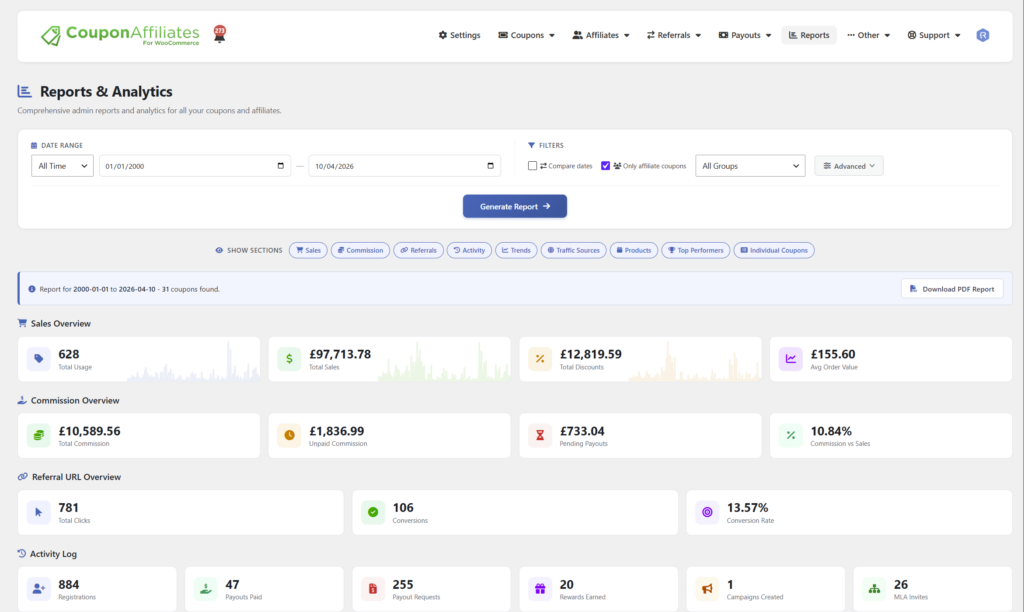
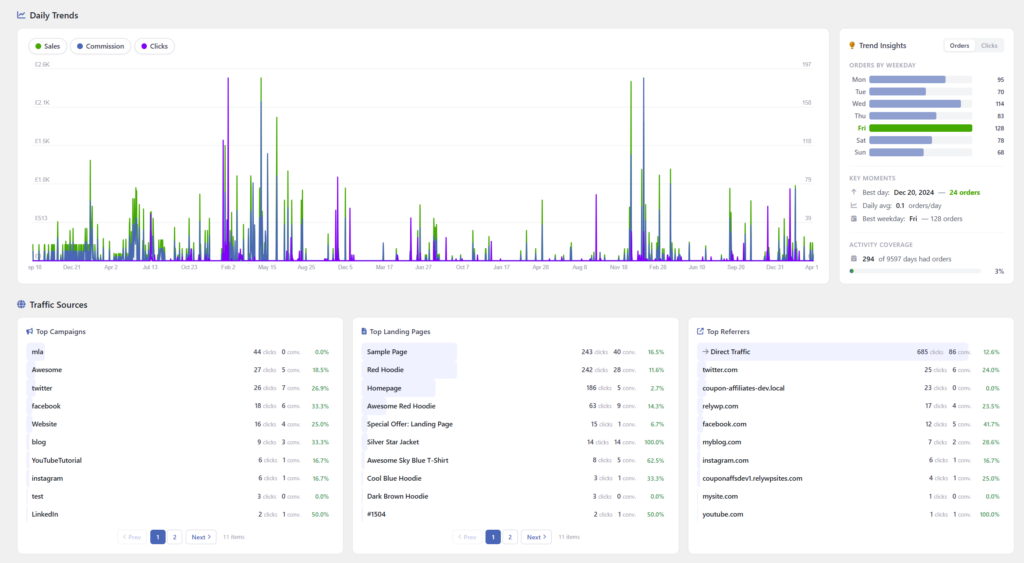
Your affiliate plugin should give you the affiliate-specific figures. In Coupon Affiliates, the admin reports show total sales, total discounts, AOV, total and unpaid commission, commission as a share of sales, referral link clicks, conversions and conversion rate. There’s also a daily trend chart, traffic sources (campaigns, landing pages and referring sites) and your top coupons and products. The PRO version adds any date range, comparisons between periods, filtering by affiliate group and CSV export.
For affiliates themselves, the PRO affiliate email reports can include earnings per click, average order value and new versus returning customers, with the change against the previous period. That’s useful when you want affiliates watching the same numbers you are.
WooCommerce Analytics gives you total store revenue (for the share-of-revenue KPI) and a Coupons report with orders and discounts per code. Google Analytics covers overall site traffic and landing page behavior.
A few KPIs need a quick spreadsheet whatever tool you use: ROI (because it needs your margin), active affiliate rate, top-affiliate share and CLV.
Building an affiliate KPI dashboard
A one-page dashboard stops these numbers getting lost across reports. Put affiliate revenue, share of store revenue and cost of sale in the top row, since those are the ones you’ll glance at most. Underneath, keep the monthly figures (AOV, conversion rate, active affiliate rate) and a quarterly block for ROI and top-affiliate share.
A shared spreadsheet updated once a month from your reports is enough for most stores. If you want it to update itself, Coupon Affiliates has a REST API for pulling the statistics into a dashboard tool.
Frequently asked questions
What are the most important KPIs for affiliate marketing?
For a store running its own program: affiliate revenue, cost of sale, ROI, new-customer share and active affiliate rate. Between them they cover profit, new-customer growth and how exposed you are to a few partners.
What’s the difference between a KPI and a metric?
A metric is any number you can measure, like clicks. A KPI is a metric you’ve decided to judge the program by, usually with a target attached. Clicks are a metric; cost of sale under 20% is a KPI.
What is a good conversion rate for affiliate traffic?
It depends heavily on your niche, prices and the type of affiliate. A practical test is to compare affiliate link traffic with your store’s overall conversion rate. If it’s well below, look at landing pages and whether the audience fits the product.
How do you calculate affiliate marketing ROI?
Take the gross profit from affiliate orders (based on net sales, after discounts), subtract the program cost (commission, bonuses and software), then divide by the program cost and multiply by 100. Use profit rather than revenue, or the result will look far better than it is.
What is EPC in affiliate marketing?
EPC means earnings per click: an affiliate’s commission divided by the clicks they sent. Affiliates use it to compare programs, so a higher EPC makes your program easier to recruit for.
How do I track KPIs for a coupon-code affiliate program?
Credit every order to the affiliate whose code was used, count the coupon discount as part of your cost, and only calculate conversion rate on orders that came through referral links. A plugin that tracks both codes and links, such as Coupon Affiliates, keeps these separate for you.
PS: Want these numbers without building them by hand? Coupon Affiliates tracks affiliate sales, commission, clicks and conversions inside WooCommerce. Start with the free version, or try PRO with a 7-day free trial.

Priyanka is a writer for WordPress and eCommerce companies. She loves breaking down complex ideas into simple concepts.

Leave a Reply