

Influencer affiliate marketing is when a brand pays creators a commission on the sales they drive, instead of (or as well as) a flat fee per post. Each influencer gets their own affiliate link or discount code, so every sale they bring in is tracked back to them and paid out.
To build an influencer affiliate program, pick creators whose audience matches your customers, make them an offer worth promoting, give them a brief along with their own code or link, then track sales and reward the people who sell. This guide walks through each step, plus the commission structures, links and codes that make it work.
Quick disclosure: we make Coupon Affiliates, a WooCommerce plugin for coupon-based affiliate and influencer programs, so the WooCommerce section uses it as the example. Everything else applies whichever tool you use.
Jump to a section:
- What is influencer affiliate marketing?
- What is an influencer affiliate link?
- Affiliate marketing for influencers: how it works
- Why brands run influencer affiliate programs
- How to create an influencer affiliate program in 5 steps
- Common mistakes to avoid
- Running an influencer affiliate program on WooCommerce
- Frequently asked questions
What Is Influencer Affiliate Marketing?
Influencer affiliate marketing is a performance-based partnership. A creator promotes your products to their audience and earns a commission on the sales (or sometimes leads) they generate. Each influencer gets a unique trackable link or discount code to share in their videos, posts, stories, newsletters or podcasts. When a follower buys with it, the sale is credited to that creator.
Influencer marketing vs influencer affiliate marketing
The difference comes down to what you pay for and when. Traditional influencer marketing buys content and reach for a fixed fee. The affiliate version ties pay to sales:
| Traditional influencer marketing | Influencer affiliate marketing | |
|---|---|---|
| How you pay | Flat upfront fee or free products | Commission on each sale or lead |
| When you pay | Before results, on agreement | After results, once a sale lands |
| Main goal | Brand awareness and engagement | Trackable sales |
| Risk to the brand | Higher, since you pay whatever happens | Lower, since cost follows revenue |
| How it’s tracked | Reach, impressions, engagement | Affiliate links and discount codes |
| Best suited to | Launches and big-reach moments | Ongoing sales from creators |
In practice, a makeup brand might pay a beauty creator $5,000 for one YouTube review, while a tech blogger earns 10% on every gadget sold through their affiliate link. The two models aren’t mutually exclusive. Plenty of brands add a commission on top of a paid partnership so the creator keeps promoting after the sponsored post.

What Is an Influencer Affiliate Link?
An influencer affiliate link is a tracked URL that belongs to one creator. When a follower clicks it, the store records which influencer sent them (usually with a cookie) and credits any purchase made within the tracking window to that influencer.
Many influencer programs use a discount code instead of a link, or alongside one. A code does the same job: when a customer types it in at checkout, the sale is credited to the creator who owns it. The difference is that a code still works where a link can’t, such as a podcast read, a video watched on a TV, a story with no link sticker, or a follower who saw the post on their phone and bought later on a laptop.
Codes are also the more common choice. In Influencer Marketing Hub’s 2026 benchmark report, based on a survey of 600+ respondents, promo and discount codes were the most used measurement tool among those who answered (45.9%), ahead of affiliate links (26.0%).
Most programs give each creator both: a link for bios, descriptions and newsletters, and a short code for anything spoken or shown on screen. Our guide to tracking affiliate sales with coupon codes explains how code-based tracking works and where cookie tracking falls short.
Affiliate Marketing for Influencers: How It Works
From the creator’s side, the process is simple. They join a brand’s program (or get invited), receive their own link or code, share it in their content and earn a commission on each sale it produces. Most programs also give affiliates a dashboard to check their clicks, sales and earnings, and pay out on a schedule by PayPal, bank transfer or store credit.
Knowing what creators look for helps you write an offer they’ll accept. The influencers worth working with usually want:
- A product their audience will thank them for recommending
- A commission that’s worth the time it takes to make the content
- A discount code to give followers, which makes the post easier to sell
- Stats they can check themselves, and payments that arrive when promised
Why Brands Run Influencer Affiliate Programs
Influencer marketing and affiliate marketing both work on their own. Combined, you keep the reach and trust creators bring while only paying when something sells.
It puts you in front of the right audience
The right influencer puts your brand in front of people who already care about your category. Even the followers who don’t buy straight away now know you exist, and that familiarity makes them likelier to buy later.
It creates social proof
Commission-based creators still publish real content about your products: reviews, unboxings, tutorials, before-and-after posts. Each one works as an endorsement, and over months they add up to a library of people vouching for you that no ad can match.
You pay for sales, not posts
Unlike campaigns that pay upfront, commission gives creators a reason to keep promoting long after the first post goes live. Your cost rises only when revenue does, which makes it easier to test a lot of smaller creators and keep the ones whose audiences buy.
How to Create an Influencer Affiliate Program in 5 Steps
This is the order we’d follow to get a program running.
1. Find influencers whose audience buys what you sell
Everything rests on finding the right partners. Look past follower count. What you want is an audience that overlaps with your customers, and a creator who can talk about your product without it sounding forced. Engagement and topical fit matter far more than reach.
Smaller creators are often the better bet. A micro-influencer with 20,000 followers in your niche can sell more than a celebrity whose audience is spread across every interest, and they’re more likely to say yes to a commission-based deal. Your own customers are worth checking too, since some of them already post about you.
To find creators, use a discovery tool like Upfluence, Aspire or Heepsy, or search by hand: relevant hashtags, the creators your competitors work with, and niche communities. Once you have a shortlist, reach out with a personal pitch that explains why your product suits their content. If you plan to work with creators on different terms, set them up as their own affiliate group.
2. Choose a commission structure
Commission-only deals are the default, but they aren’t the only option. These are the structures most programs use with influencers:
| Structure | How it works | Works best for |
|---|---|---|
| Commission only | A percentage or fixed amount per sale, nothing upfront | Micro-influencers, customers and fans of the brand |
| Gifted product plus commission | Free product to try and review, then commission on sales | Creators who haven’t used your product yet |
| Flat fee plus commission | A smaller upfront fee for the content, with commission on top | Established creators who won’t work on commission alone |
| Tiered rates or bonuses | Higher rates or one-off bonuses after a sales target | Your best performers, to keep them promoting |

For the rate itself, start from your margins and your category. Our guide to affiliate commission rates puts physical goods at 5% to 15% per sale and digital products at 20% to 50%. Creators also care about the discount their followers get, so a slightly lower commission paired with a good code can beat a high commission with no discount.
Tip: Write down two or three standard offers (for example, gifted product plus 10%, or 15% with a bonus at 50 sales). It makes pitching new creators much quicker, and keeps your terms consistent.
3. Write a clear influencer brief
A good brief sets expectations for what to post, where and when, without scripting the creator. Include:
- Brand overview. A short intro to who you are, who buys from you and what sets you apart.
- Brand assets. Logos, approved images and product photos.
- Key points. The features and benefits to mention, and anything they must not claim.
- Formats and platforms. Reels, TikToks, YouTube videos, stories, blog posts or newsletters.
- Their link and code. What each one is for, and the discount followers get.
- Disclosure rules. In the US, the FTC expects creators to disclose any financial relationship with a brand, and a commission counts. In the UK, the ASA influencers’ guide covers affiliate content and how to label ads.
- Timing. Any launch dates, sale periods or deadlines they should plan around.
4. Give creators their code, then step back
Set each influencer up with their code and link before they start, and consider a personal landing page that shows their name and discount. Coupon Affiliates can build affiliate landing pages automatically.
Then offer ideas and let them work. Creators know their audience better than you do, and content in their own voice sells better than anything you script. Early access to new products, behind-the-scenes looks and giveaways give them fresh things to post about without dictating the content.
5. Track performance and refine
An influencer program isn’t something you set up once and leave. Watch which creators sell, which formats work and which offers people respond to.
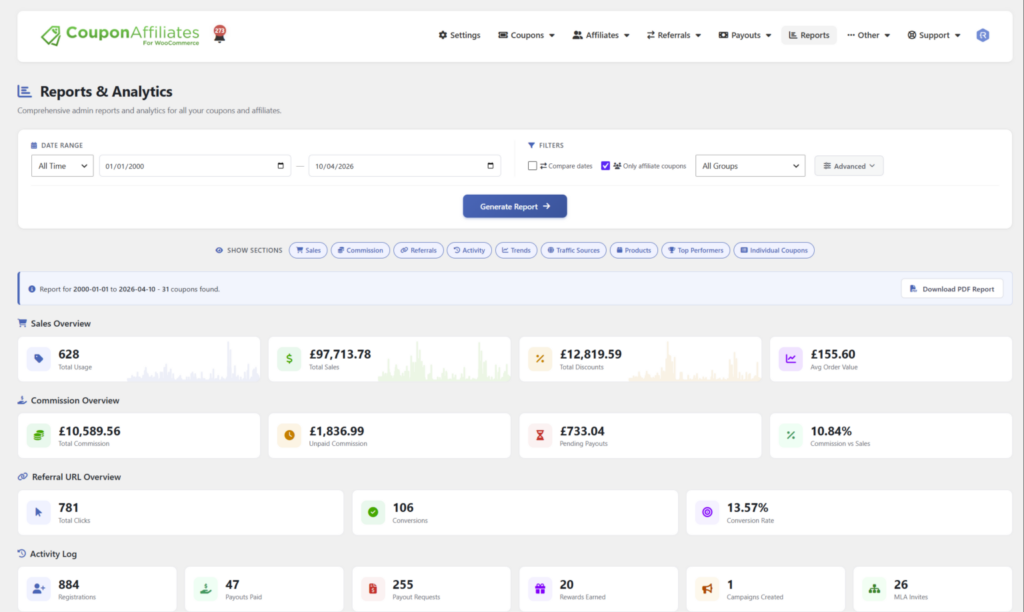
Your affiliate plugin should report the metrics that matter for each creator: orders, revenue, commission, clicks and conversion rate. Reward the people who sell with better rates or bonuses. When an influencer’s audience isn’t buying, try a different angle or offer before you move on.
After your first round of creators, ask them what would make promoting you easier. From there you can set different commission rates for your best partners, add reward tiers, and automate the repetitive admin.
Common Mistakes to Avoid
- Recruiting on follower count alone. A big audience outside your niche won’t buy. Engagement and fit matter more.
- Setting the wrong commission. Too low and good creators won’t bother. Too high and the numbers stop working. Start from your margins.
- Handing over a vague brief. No direction leads to off-message content and rework.
- Launching without tracking. If you can’t credit a sale to a creator, you can’t pay fairly or see what’s working.
- Treating it as one-and-done. The programs that last treat influencers as ongoing partners, not single placements.
Running an Influencer Affiliate Program on WooCommerce
If your store runs on WooCommerce, you don’t need a separate influencer platform to do any of this. Coupon Affiliates gives each creator their own coupon code and referral link, credits every sale to the right person, calculates commission and handles payouts inside WordPress. More than 7,000 websites use it, across the free and PRO versions.
Because tracking is built around coupon codes, sales are credited even when nobody clicks a link, which suits how most influencers promote. See how to track influencer sales with coupon codes in WooCommerce, or compare options in our roundup of the best WooCommerce affiliate plugins, which includes plugins that suit link-led programs better than ours.
Frequently Asked Questions
What is influencer affiliate marketing?
A performance-based partnership where influencers promote a brand and earn a commission on the sales they generate. Each creator gets their own link or discount code, so every sale can be tracked back to them and paid accurately.
How is it different from regular influencer marketing?
Traditional influencer marketing pays a flat fee upfront for content and reach, whatever happens to sales. Influencer affiliate marketing pays when the creator drives a sale, so your cost follows your revenue.
Should I give influencers affiliate links or discount codes?
Usually both. Links work well in bios, descriptions and newsletters. Codes work everywhere else, including podcasts, videos and stories, and they give followers a reason to buy. If you only use one, codes catch the sales that links miss.
How much commission should I pay influencer affiliates?
It depends on your margins and category. As a starting point, physical products often pay 5% to 15% per sale and digital products 20% to 50%. Add bonuses or higher tiers for the creators who sell the most.
How do I find influencers for my affiliate program?
Use a discovery tool like Upfluence, Aspire or Heepsy, or search by hand through hashtags, competitor collaborations and niche communities. Check your own customers too. Prioritize audience fit and engagement over follower count.
Do influencer affiliates need to disclose affiliate links?
Yes. In the US, the FTC expects creators to clearly disclose any financial relationship with a brand, including commission. In the UK, the ASA expects affiliate content to be labeled as advertising. Put your disclosure rules in the brief so every post is covered.
Start Small, Then Scale What Works
You don’t need dozens of influencers to begin. Five or ten well-matched creators with a fair commission, a clear brief and their own code will tell you within a couple of months which audiences buy, and those are the partnerships worth building on.
We make Coupon Affiliates, so take our WooCommerce advice with that in mind. If you’d like to try it, the free version of Coupon Affiliates covers the basics and PRO has a 7-day free trial.

Priyanka is a writer for WordPress and eCommerce companies. She loves breaking down complex ideas into simple concepts.
Leave a Reply