
Coupon affiliate marketing is when a brand gives each affiliate their own discount code instead of (or alongside) a referral link. Customers get money off when they use the code, the sale is credited to the affiliate who owns it, and the brand pays that affiliate a commission.
It’s one of the simplest ways to run an affiliate program, because codes work anywhere people can say or type them. The decisions that make or break it are who gets a code, how the discount and commission add up, whether coupon sites are allowed in, and how you stop codes from leaking. This guide covers each one from the brand’s side.
Quick disclosure: we make Coupon Affiliates, a WooCommerce plugin built around coupon-based affiliate programs, so we’re not neutral on this topic. We cover the downsides too.
Jump to a section:
- What is coupon affiliate marketing?
- The three kinds of coupon affiliates
- What a coupon sale really costs
- Should you let coupon sites in?
- Choosing how your codes work
- Keeping codes from leaking
- When coupon affiliate marketing isn’t a good fit
- Frequently asked questions
What Is Coupon Affiliate Marketing?
In a standard affiliate program, a partner shares a tracked link and earns commission when someone clicks it and buys. In a coupon affiliate program, the partner shares a code instead. The code does two jobs at once: it gives the customer a reason to buy now, and it tells you which affiliate sent them.
Because the code is part of the order, the sale is credited even when there was no click, such as when someone hears the code on a podcast or sees it in a video and types it in days later. Our guide to cookieless affiliate tracking explains the tracking side in more detail, and the WooCommerce affiliate marketing guide covers when to use links, codes or both.
Coupons are a big part of affiliate marketing as a whole. Discount and coupon publishers took 42.4% of US affiliate revenue in the first half of 2025, according to Awin data reported by eMarketer, up from 39.7% a year earlier. The same coverage notes that creators’ share of revenue on Awin’s network rose from 15.9% to 19.5%, and creators are often the partners sharing a personal code.
The Three Kinds of Coupon Affiliates
“Coupon affiliate” covers very different partners, and they use codes in different ways. Most programs end up with some mix of these:
| Affiliate type | How they use the code | What they’re good for | What to watch |
|---|---|---|---|
| Creators and influencers | Say or show a personal code (like SARAH15) in videos, posts, podcasts and streams | Reaching new customers who trust the creator | Codes that get reposted beyond their audience |
| Customers and brand ambassadors | Share a personal code with friends, family and followers | Low-cost word of mouth from people who already buy | Using their own code on their own orders |
| Coupon and deal sites | List your codes for people searching “your brand + discount code” | Volume, seasonal promotions and closing hesitant buyers | Paying commission on sales you would have made anyway |
Creators and ambassadors usually bring you new customers. Coupon sites are different, which is why they get their own section below. For more on each partner type and where to find them, see our guide to types of affiliates.
What a Coupon Sale Really Costs
With a link-only affiliate, your cost per sale is the commission. With a coupon affiliate, it’s the commission plus the discount the customer gets, and the two add up faster than most stores expect.
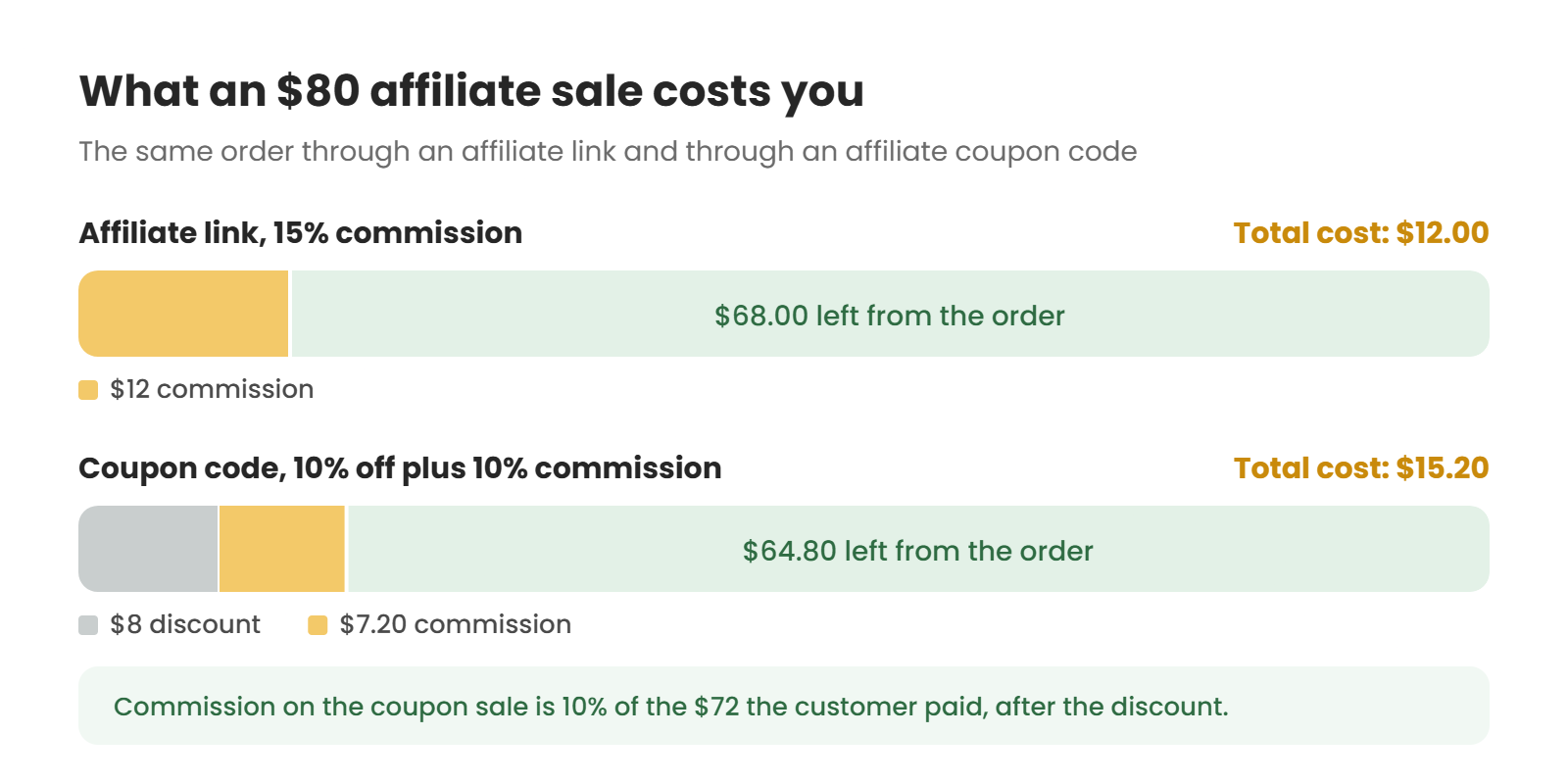
Here’s an example. An $80 order through an affiliate link paying 15% commission costs you $12. The same order through an affiliate code with 10% off and 10% commission costs you $8 in discount plus $7.20 in commission (10% of the $72 the customer paid), which is $15.20 in total. The coupon sale costs more, even though the commission rate is lower.
That doesn’t make codes a bad deal. A code often converts better than a link, and it brings in customers who never would have clicked. It does mean you should set the discount and the commission together, as one budget, rather than picking each in isolation. A few things to check:
- Whether your plugin calculates commission on the price before or after the discount. It changes the numbers above.
- How many extra sales the discount needs to pay for itself. Our discount break-even calculator works this out from your margin.
- How your rates compare with your category. Our guide to affiliate commission rates has typical ranges.
Some programs give creators a larger discount and a smaller commission, since a good discount makes their post easier to sell. Others do the opposite for partners who reach people ready to buy anyway. Either works, as long as the total fits your margin.
Should You Let Coupon Sites Into Your Program?
This is the most debated question in coupon affiliate marketing. Coupon and deal sites rank for searches like “your brand discount code”, so they show up at the exact moment a customer is about to pay. That makes them very good at converting, and often very good at taking credit for sales your other marketing created.
The common pattern goes like this: a customer finds you through an influencer or an ad, fills their basket, then searches for a discount code before paying. They find a coupon site, use the code listed there, and you pay a discount and a commission on a sale that was already happening. Because the sale is credited to whichever code is used at checkout, the coupon site gets it, not the creator who introduced the customer.
There’s no single right answer, but most brands pick one of these approaches:
| Approach | How it works | Suits |
|---|---|---|
| Don’t allow coupon sites | Your terms ban affiliates from posting codes on coupon and deal sites | Brands with established creator or ambassador programs |
| Allow them on separate terms | Coupon sites get a lower commission, or only first-order codes | Brands that want the volume but not the overlap |
| Use them for promotions only | Coupon sites get exclusive codes for specific sales, like Black Friday | Brands that run regular sales events |
| Allow them on standard terms | Coupon sites work like any other affiliate | New brands with little search demand yet |
Whatever you choose, write it into your affiliate terms before you recruit anyone. In Coupon Affiliates, you can limit affiliate coupons to new customers in the free version, and give coupon sites their own commission rate with an affiliate group in PRO. Our affiliate groups guide explains how groups work.
Choosing How Your Codes Work
Most coupon affiliate programs use one code per affiliate, but there are a few setups to choose from:
- Personal vanity codes. A code based on the affiliate’s name, like SARAH15. Easy to say and remember, which makes them the default for creators.
- Generated codes. A code created automatically in a set format when each affiliate is approved. Quicker to manage at scale, and harder to guess.
- Campaign codes. A separate code for one promotion or one channel, so you can see exactly which campaign drove the sales.
- Single-use codes. One code per customer. Hard to leak, but impractical for creators who share one code with a whole audience.
The deal behind the code matters as much as the code itself: a percentage off, a fixed amount, free shipping or a free gift. Our list of coupon code ideas and formats covers the options, and the coupon code name generator can suggest names.
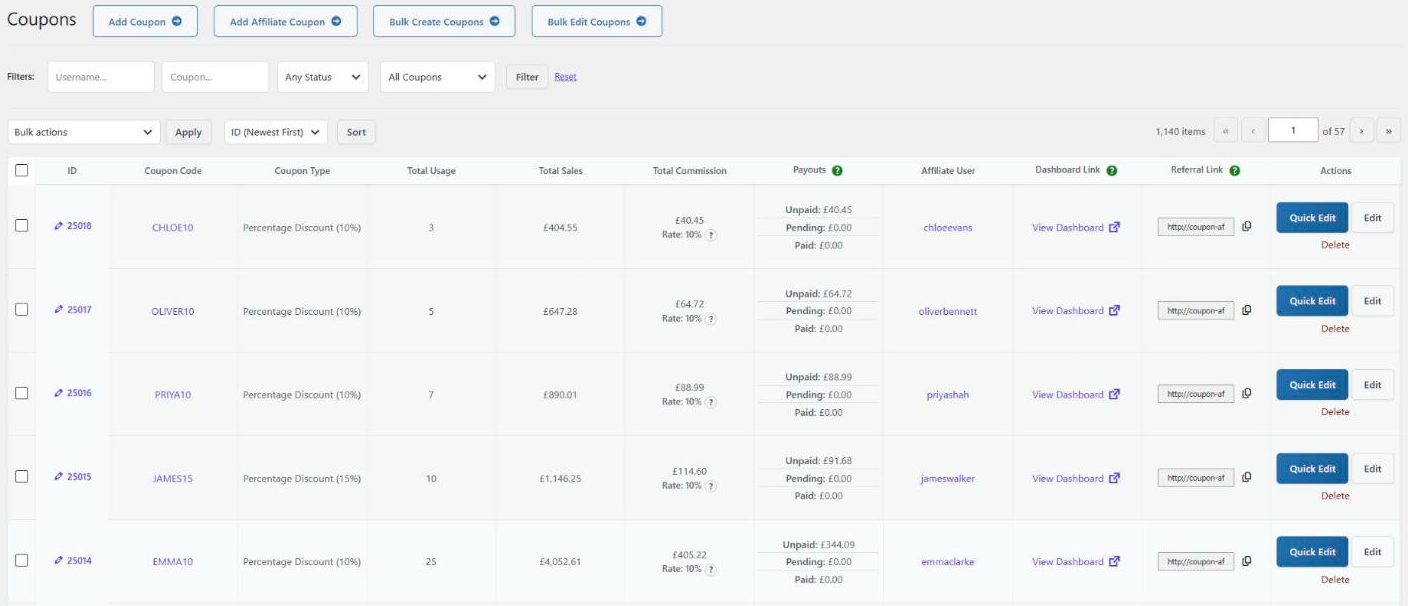
In Coupon Affiliates, each new affiliate’s coupon is created from a template coupon you set up once, so every code starts with the same discount, usage limits and product restrictions. That’s in the free version. Generating codes in your own custom format is part of PRO.
Keeping Codes From Leaking
The weak point of any coupon program is that a code can travel. Once a code is posted somewhere public, anyone can use it, and the affiliate earns commission on customers they never reached. The basics that prevent most problems:
- Ban posting codes on coupon sites in your terms, unless you’ve chosen to allow it
- Limit affiliate codes to new customers, if your goal is acquisition
- Block affiliates from using their own codes on their own orders
- Watch your reports for codes with sudden spikes from unfamiliar customers
- Retire a leaked code and issue the affiliate a new one
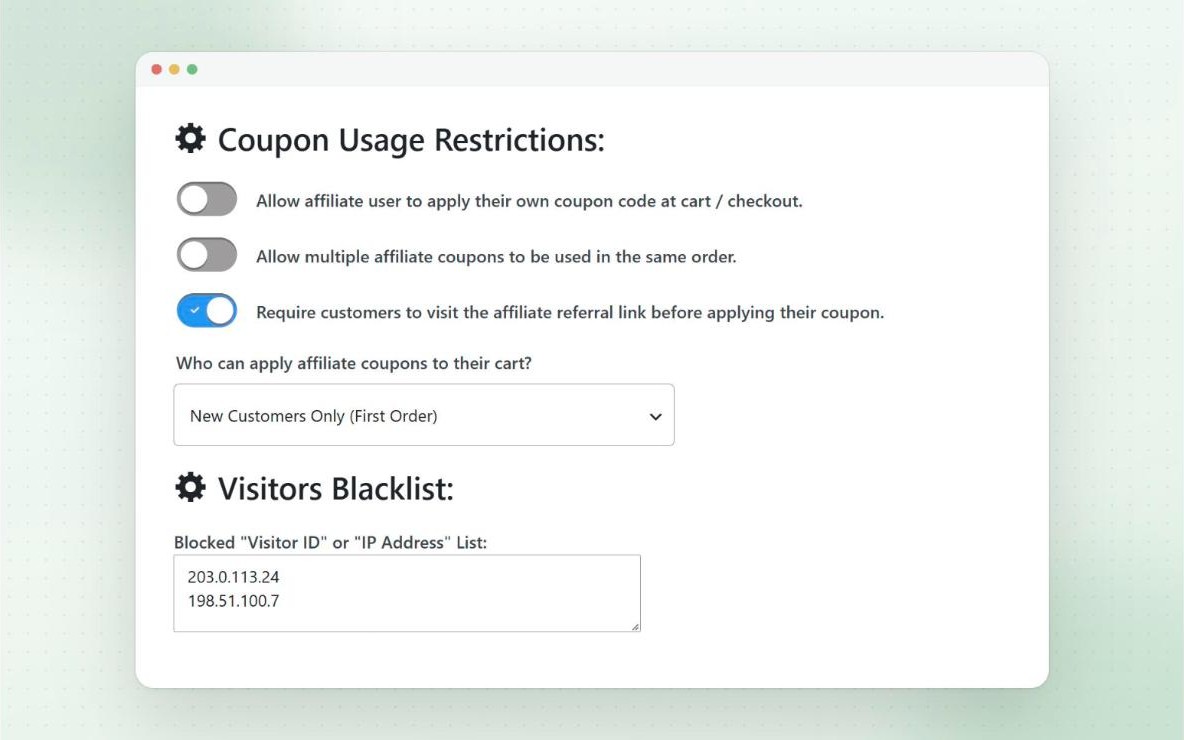
In Coupon Affiliates, limiting codes to new customers and blocking affiliates from using their own codes are settings rather than manual checks:
Our guide to preventing affiliate coupon abuse goes through each of these, including how codes end up on sites like Honey and RetailMeNot.
When Coupon Affiliate Marketing Isn’t a Good Fit
Coupon codes don’t suit every business. They’re a harder sell when:
- Your margins are thin. Discount plus commission can wipe out the profit on each order.
- Your brand avoids discounting. Luxury and premium brands often protect their pricing, and a constant stream of codes works against that.
- Your customers already wait for a code. If shoppers have learned to search for one before every purchase, more codes can make the habit worse.
- You sell high-value services. B2B deals and quotes rarely go through a checkout where a code can be entered.
In those cases, a link-based program, a fixed reward with no customer discount, or a small number of hand-picked partners can work better. Codes and links aren’t an either-or choice, and many programs use codes only for the partners they suit.
Running a Coupon Affiliate Program on WooCommerce
WooCommerce already has coupons built in, which is what makes coupon affiliate programs a natural fit for it. Coupon Affiliates links each affiliate to their own WooCommerce coupon, credits every order that uses it, and gives the affiliate a dashboard with their sales and commission. Referral links that apply the coupon automatically are included too, for partners who prefer links.
For the full setup, see our guide to creating a coupon-based affiliate program in WooCommerce, or the broader step-by-step WooCommerce affiliate program guide.
Frequently Asked Questions
What is a coupon affiliate?
A partner who promotes a brand with their own discount code and earns a commission on sales that use it. Coupon affiliates can be creators, customers, brand ambassadors or coupon and deal websites.
How do coupon affiliate programs track sales?
The affiliate’s code is tied to their account. When a customer enters it at checkout, the order is credited to that affiliate automatically, with no link click or cookie needed.
Do coupon affiliates need a website?
No. Many share their code on social media, in videos, podcasts, newsletters or in person. That’s one of the main reasons brands use coupon codes rather than links alone.
Should affiliates get a code and a link?
Usually, yes. Links work well where people click, like blogs, bios and emails. Codes work where people listen, watch or talk. Giving both lets each affiliate use whichever suits their audience.
How big should an affiliate coupon discount be?
Big enough to give customers a reason to buy, small enough that the discount plus the commission still leaves you a profit. Start with a modest discount, such as 10%, and adjust once you see how it sells. The break-even calculator shows what each discount needs to pay for itself.
Start With the Partners Codes Suit Best
Coupon affiliate marketing works best when you treat the discount and the commission as one cost, decide early how you’ll handle coupon sites, and give codes to the partners whose audiences actually use them. Creators and existing customers are usually the easiest place to start.
We make Coupon Affiliates, so we’re biased toward coupon-based programs, and the downsides above are real. If you’d like to try it on your store, the free WooCommerce affiliate plugin covers the basics and PRO has a 7-day free trial.

Elliot Sowersby is a WordPress developer from Yorkshire, United Kingdom. He is the founder and lead developer of Coupon Affiliates and RelyWP.

Leave a Reply