
Should you run an in-house affiliate program or join an affiliate network? Use a network if you need partners you can’t find on your own and nobody on your team has time to go looking. Networks like Awin and impact.com put your program in front of publishers who have already signed up with them, and that reach is what you’re paying for.
Run your program in-house if your affiliates are creators, customers or partners you’ll recruit yourself anyway, and especially if they’ll promote you with coupon codes. You skip the network’s cut of every sale, and the affiliates you sign up stay on your list rather than the network’s.
The fee difference is bigger than most store owners expect. Awin’s entry-level US plan charges 3.5% of the value of every affiliate sale, on top of the commission you pay the affiliate. If your commission is 10%, that adds 35% to your affiliate costs.
Jump to what matters to you:
- Need publishers you can’t find yourself? Recruitment is where networks win
- Working with creators or discount codes? How tracking differs
- Mostly worried about cost? Network fees vs software
- Just want the answer? Which should you pick
A quick disclosure: we make Coupon Affiliates, a WooCommerce plugin for running an in-house affiliate program, so we’re on one side of this decision. We’ve tried to be straight about when a network is the better choice, and every network price below comes from that network’s own pricing page.
How We Compared the Two
We took plan prices and fees from the US pricing pages of Awin and impact.com on October 4, 2026. Our own prices come from the Coupon Affiliates pricing page on the same day. CJ doesn’t publish advertiser pricing, so it’s not in the cost table. The cost examples leave commission out, since you pay that whichever route you choose.
We then looked at what a pricing page doesn’t tell you, such as who keeps the affiliate relationships if you leave and how sales get tracked.
How Affiliate Networks Work
A network sits between you and the publishers (the blogs, creators and deal sites that promote you). You sign a contract and add the network’s tracking tag (a small piece of code that records each sale) to your checkout. Your program then appears in the network’s directory, where publishers can find it and apply, and approved publishers promote you with links the network generates. When a sale tracks, the network bills you for the commission plus its own fee, then pays the publisher.
For stores selling in the US and UK, the names you’ll hear most are Awin, impact.com, CJ and Rakuten Advertising. ShareASale used to be on that list. Awin, which bought it in 2017, moved its customers onto the Awin platform in 2025 and closed ShareASale on October 6, 2025. Any advice telling you to start on ShareASale is out of date.
An in-house program removes that middle layer. You run it on your own site with affiliate software (for a WooCommerce store, that’s usually a plugin), recruit affiliates yourself and pay them directly. If you’re new to affiliate programs in general, our guide to WooCommerce affiliate marketing explains how they work. This post only covers where to run yours.
Network Fees vs Software Costs
Networks usually charge a monthly platform fee plus a percentage of each tracked sale. The percentage is taken from the sale value, not from the commission. Awin’s own example on its pricing page: on a $100 sale with 6% commission, the partner gets $6 and Awin gets $3.50 on the Access plan.
Software for an in-house program is normally a flat subscription or a one-off license, with nothing taken per sale. Here’s what each option costs per month at three levels of affiliate-driven sales, not counting commission:
| Option | Published price | $2,000/mo in affiliate sales | $10,000/mo | $50,000/mo |
|---|---|---|---|---|
| Awin Access | $49/mo + 3.5% per sale | $119 | $399 | $1,799 |
| Awin Accelerate | From $99/mo + 2.5% per sale | $149 | $349 | $1,349 |
| impact.com Essentials (first plan with its Partner Marketplace) | From $500/mo + 2.5% per sale, plus a one-time setup fee | $550 | $750 | $1,750 |
| impact.com Starter (tracking only, no marketplace) | From $30/mo + 2.5% per sale | $80 | $280 | $1,280 |
| Coupon Affiliates PRO, yearly | $179.99/yr, no per-sale fee | $15 | $15 | $15 |
| Coupon Affiliates free version | $0 | $0 | $0 | $0 |
Last updated: October 4, 2026, from each vendor’s US pricing page. Awin Accelerate and the impact.com plans are “from” prices, so your quote could be higher. impact.com doesn’t publish its setup fee; it says the amount depends on how much technical help your onboarding needs.
Once affiliate sales pick up, the percentage is the part you’ll notice. At $50,000 a month in affiliate sales, Awin Access comes to about $21,600 a year in fees before a single commission is paid.
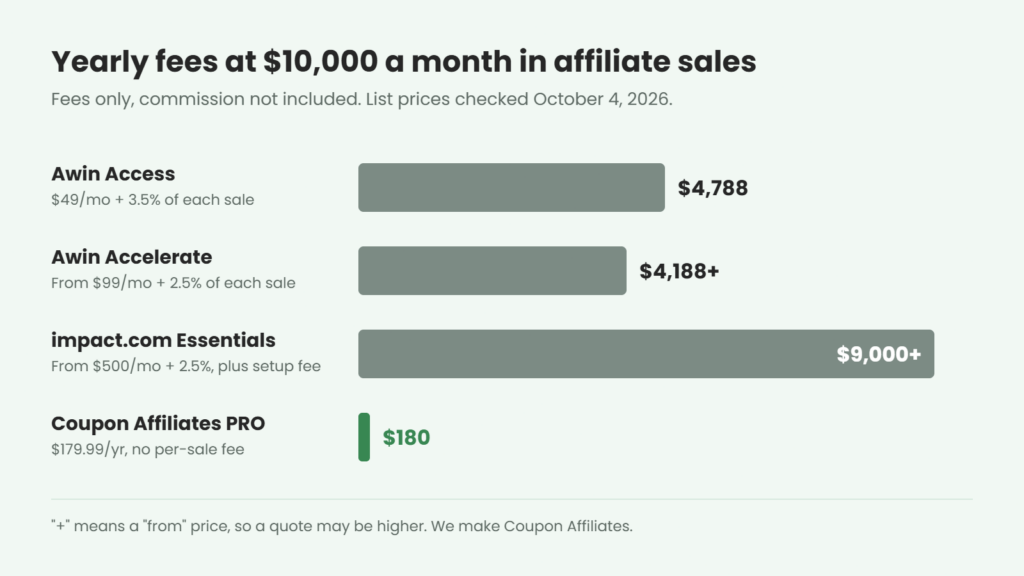
To be fair to the networks, that money buys something. You get a directory of publishers, and the network handles paying them, which publishers like because they already trust it to pay on time. In-house programs have costs of their own that a pricing page won’t show you:
- Someone’s time to find affiliates and look after them. For most stores this is the biggest cost by far.
- Processing fees when you send payouts through PayPal, Stripe or Wise.
If you’d like to plug in your own margins and order values, our affiliate program ROI calculator does the sums.
Who Owns the Affiliate Relationship and the Data
On a network, publishers are the network’s members first. They sign up to Awin or impact.com under its publisher terms, and it’s the network that pays them. They join your program from inside the network’s platform, and that’s where most of your contact with them happens.
That’s fine while you stay. It starts to matter if you ever leave, because the relationships stay behind. Your best publishers would each need to join your new program. That means asking them to set up a new account and change all their links. Before you sign a network contract, check whether it limits how you can contact its publishers outside the platform.
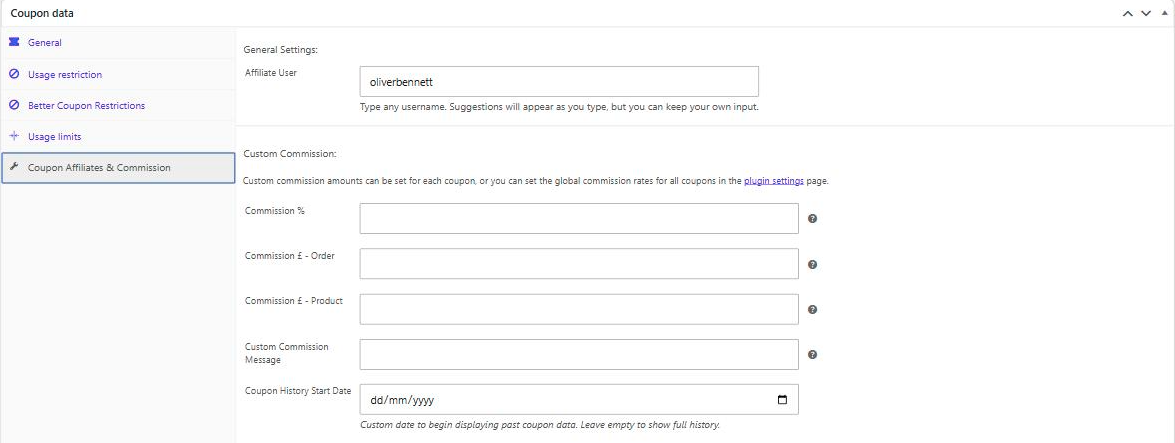
In-house, each affiliate is an account on your own site. In Coupon Affiliates, affiliates are WordPress users assigned to WooCommerce coupons, and the sales they refer are normal WooCommerce orders in your database. If you changed plugins one day, all of that would still be there.
Reporting works differently as well. On a network you see whatever your plan includes. Awin’s Access plan, for example, doesn’t include its customer journey reports or custom reports, which start on Accelerate. With an in-house program the orders are already in your store, so you can report on them however you like.
Recruitment: Where Networks Win
This is the main reason to pay a network. Awin says more than a million partners are in its directory, and impact.com’s Partner Marketplace (from the Essentials plan up) lists 90,000. With an in-house program, you start on day one with no affiliates at all.
Being listed in a directory doesn’t mean anyone will promote you, though. Some publishers will apply without being asked. Expect a good share of those to be coupon and cashback sites. Decide before you list whether you want them, because they can earn commission on shoppers who were already at your checkout. The bloggers and creators you’d most like to work with still need a personal pitch, and you’d be writing that pitch whichever route you took.
So it comes down to whether someone on your team will do the outreach. If they will, in-house usually works out cheaper, and our guide on how to recruit affiliates shows where to look. If nobody has the time, a network’s directory is the fastest way to get any partners at all.
Tracking: Network Links and Cookies vs Coupon Codes
Networks are built around tracked links. A publisher shares a link, a shopper clicks it, and the network records the click so it can match the sale later. Both Awin and impact.com can track promo codes too. On Awin, though, it’s a setting you switch on and then assign each code to a publisher, so links are still the default.
Link tracking has held up better than people predicted a few years ago. In April 2025, Google dropped its plan to phase out third-party cookies in Chrome and kept its existing cookie settings instead. Safari still blocks third-party cookies by default, and Firefox keeps them separate for each site. Sales can also go missing when someone taps a link on their phone and buys on a laptop a day later.
Coupon codes get around that. The shopper types the code at checkout, so the affiliate is credited on any device or browser, even if there was never a click. That’s why codes suit creators: their followers hear a code in a video or a podcast and use it later. An in-house coupon program tracks this way by default, and Coupon Affiliates tracks referral links as well for affiliates who prefer them. Our guide to cookieless affiliate tracking goes into how it works.
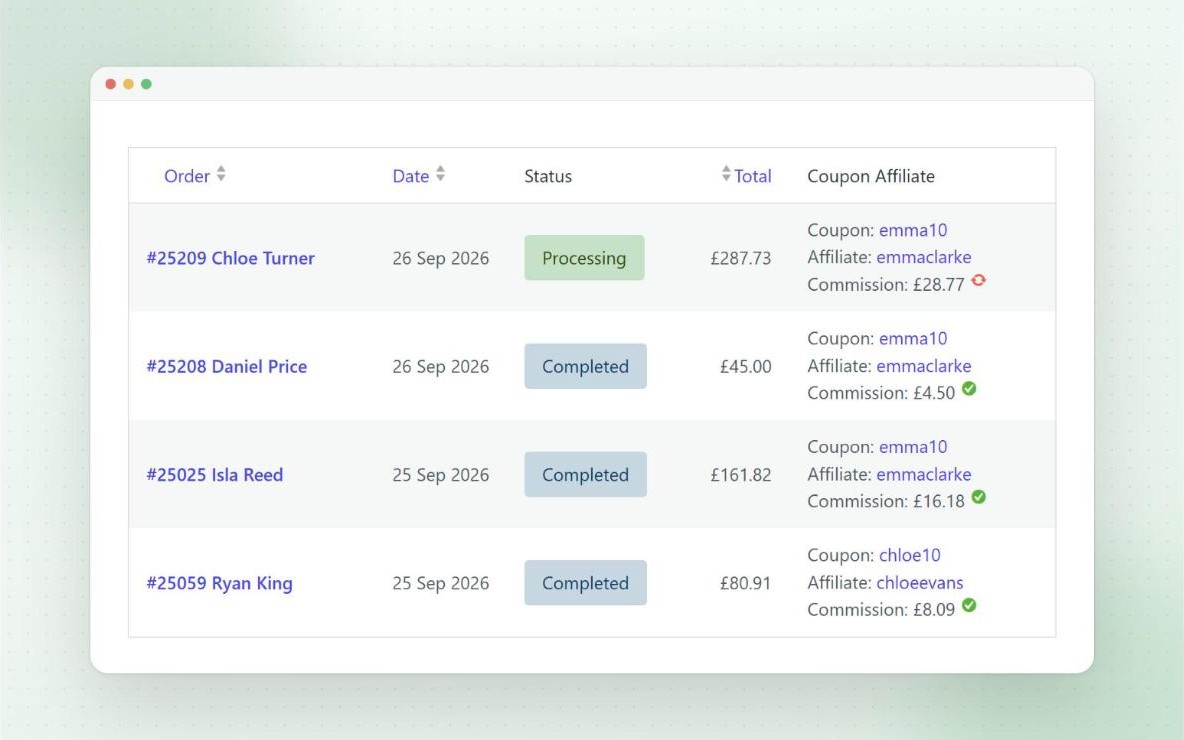
Codes come with their own problem. A creator’s code can leak onto coupon sites, where it collects sales the creator never sent. You’ll need clear terms and a way to spot it, which we cover in our post on preventing coupon abuse.
Control Over Approvals, Terms and Payouts
On a network there are two layers of rules. The network decides who can join it at all and sets its own publisher terms. You then accept or decline the publishers who apply to your program and add your terms on top. How detailed your commission rules can be depends on your plan. Awin Access allows up to three commission groups, for example, while Accelerate has no limit.
Payouts run through the network. You pay the network and it pays publishers on its own schedule. That saves you admin, but it also means you can’t pay one creator early, or in store credit, or by any method the network doesn’t offer.
Read the contract terms too. Awin Access has a three-month minimum term with 14 days’ notice to cancel, which is fairly light. impact.com’s setup fee isn’t published, so get the number in writing before you commit.
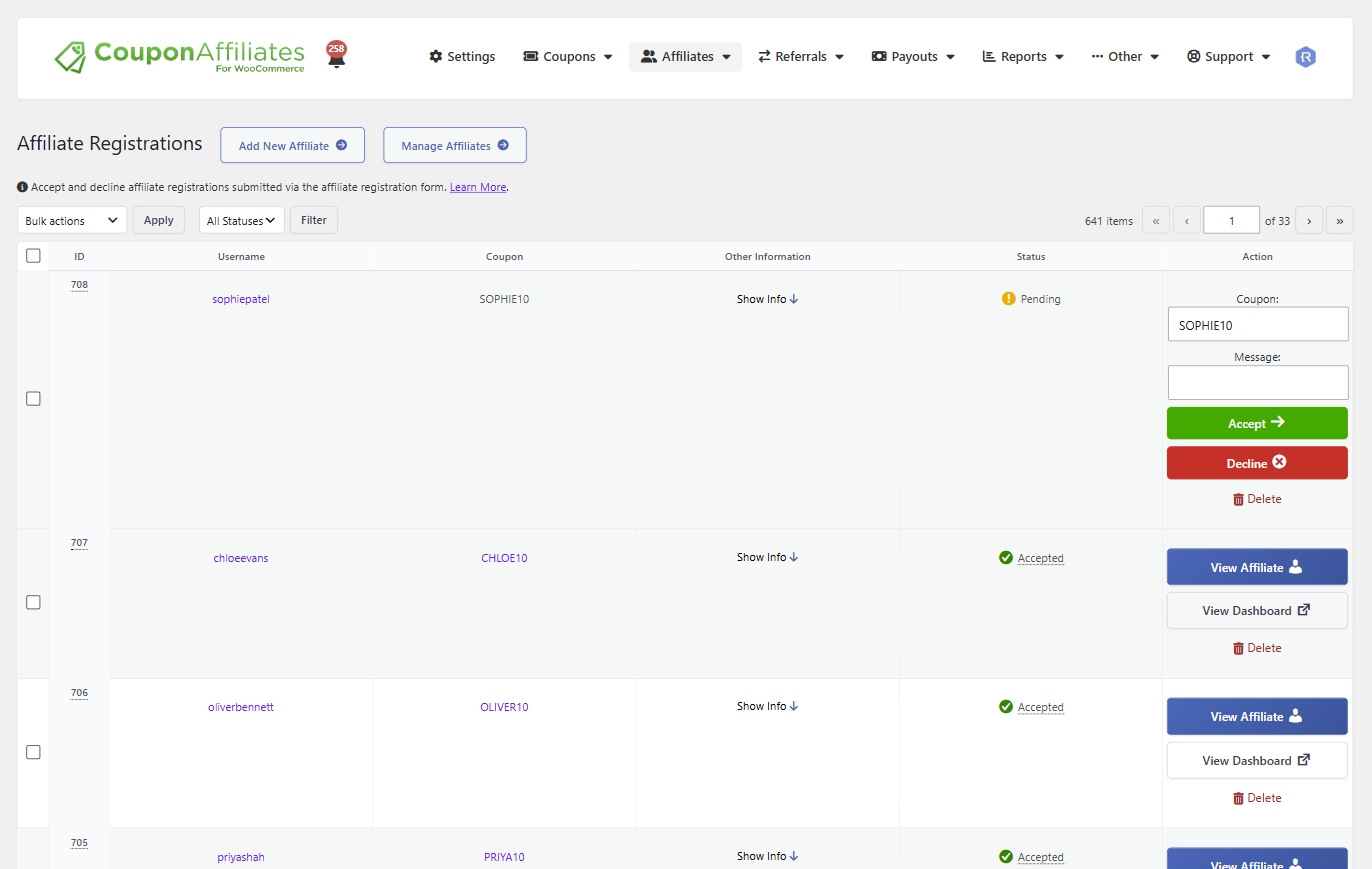
In-house, every rule is yours to set. In Coupon Affiliates, new applications wait on the Registrations page until you accept them, and PRO lets you set custom rates per affiliate or group.
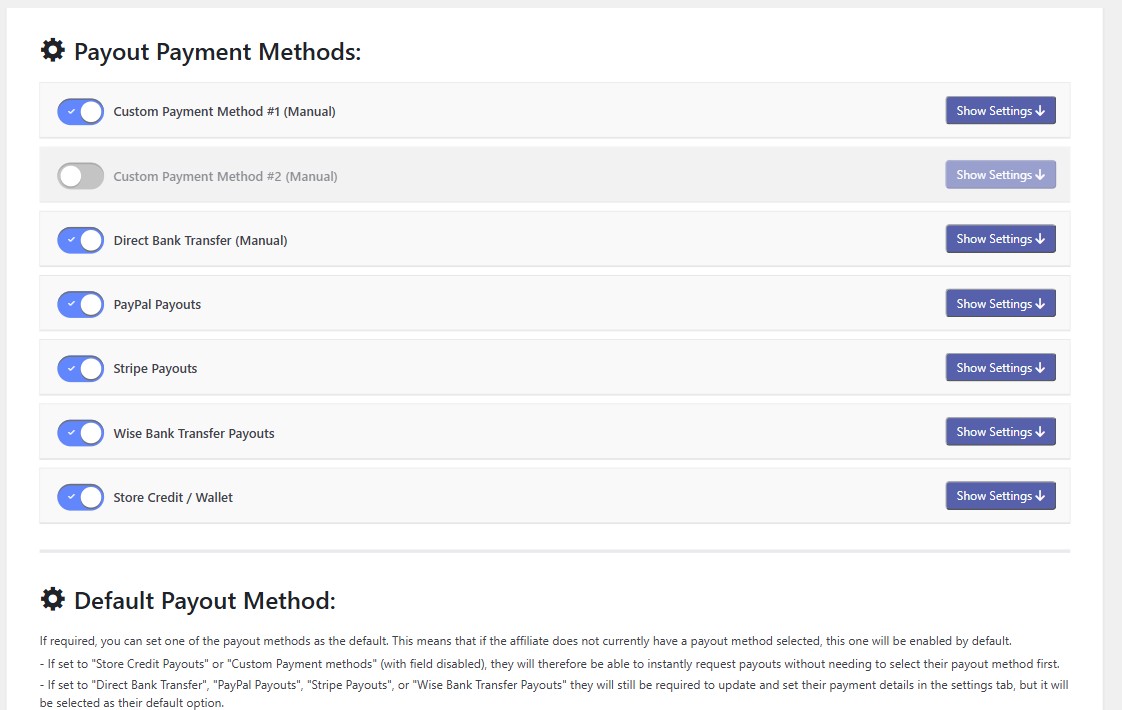
Payouts are up to you as well. With PRO you can pay affiliates through PayPal, Stripe, Wise or store credit, on a schedule you set. The full list is on our features page.
The flip side is that welcoming and training new affiliates is your job as well. Our guide to affiliate onboarding covers what to send people after they join.
In-House Affiliate Program vs Affiliate Network at a Glance
| Affiliate network | In-house program | |
|---|---|---|
| Finding affiliates | Directory of publishers already on the network | You recruit every affiliate yourself |
| Cost | Monthly fee plus a percentage of every tracked sale | Software fee, usually flat, with no cut of sales |
| Affiliate relationships | Publishers belong to the network and stay if you leave | Affiliates are accounts on your own site |
| Data | Whatever reports your plan includes | Orders and affiliate records in your own store |
| Default tracking | Tracked links; codes need extra setup | Coupon codes, links or both |
| Approvals and terms | Network vets its members, then you approve applicants | You set all of the rules |
| Payouts | Through the network, on its schedule | Paid directly by you, by the method you choose |
| Getting started | Contract, tracking tag and network onboarding | Install a plugin and configure it |
Last updated: October 4, 2026.
Affiliate network
Best for: stores that need publishers they can’t find themselves and have nobody free to recruit.
Pros:
- A ready-made directory of publishers from the day you launch
- Publishers get paid by a network they already trust, and you don’t handle payouts
Cons:
- A percentage of every sale goes to the network for as long as you stay
- Publisher relationships don’t come with you if you leave
- Links are the default, so code-led creator deals take extra setup
- Some plans add a setup fee or a minimum term, so read the contract before you sign
Pricing: Awin from $49/month plus 3.5% of each sale. impact.com’s marketplace access starts at $500/month plus 2.5% of each sale and a setup fee.
In-house program (using Coupon Affiliates as the example)
Best for: WooCommerce stores whose affiliates are people they can reach directly, especially when sales come through coupon codes.
Pros:
- No cut of your sales, however much you sell
- Affiliate accounts and the orders they refer sit in your own WooCommerce database
- Coupon codes credit the affiliate without a click or a cookie
- Approval rules and payout methods are up to you
Cons:
- No publisher directory, so you start with zero affiliates and recruit them all
- Spotting leaked codes and answering affiliate questions is your job
- You cover the PayPal, Stripe or Wise fees on payouts yourself
- Coupon Affiliates only works with WooCommerce, and automated payouts need PRO
Pricing: a free version is available. PRO is $23.99/month, $179.99/year or $599.99 once for a single site, with a 7-day free trial and no per-sale fees.
Which Should You Pick?
A network is probably the better choice if most of these apply to you:
- You need a lot of publishers quickly and don’t know where to find them.
- Nobody on your team can spend a few hours a week on outreach.
- Content and review sites in your category already work through networks.
- Your margins can take a 2.5% to 3.5% fee on top of commission.
Run it in-house if most of these sound like you:
- Your affiliates will mostly be creators or your own customers.
- They’ll share discount codes in videos or podcasts, where nobody can click a link.
- You’d rather keep the per-sale fee and own the affiliate list.
- You want to set your own approval rules and payout options.
You don’t have to choose only one. Some brands run creators through an in-house program and list on a network for extra reach. If you do that, make sure a single order can’t be credited in both systems, or you’ll pay commission on it twice. Once you’ve decided to run your own, our step-by-step guide to creating a WooCommerce affiliate program walks through the setup.
FAQ
What is an in-house affiliate program?
It’s an affiliate program you run yourself, on your own site, instead of through a network. You find affiliates yourself and pay them directly. “In-house” describes who runs the program. You’ll still use software or a plugin for the tracking rather than building it from scratch.
What is a private affiliate network?
Usually it means an invite-only program where affiliates can only join once you’ve approved them. Some networks sell this as an add-on: Awin’s Advanced plan includes branded private networks. For a store owner, an in-house program with manual approval gives you the same closed program without paying a network to host it.
Is ShareASale still open?
No. Awin moved ShareASale’s customers onto its own platform in August 2025 and closed ShareASale on October 6, 2025. Former ShareASale merchants and affiliates now use Awin.
What’s the cheapest alternative to an affiliate network?
A self-hosted affiliate plugin. Several WooCommerce affiliate plugins have free versions, ours included, and the paid ones charge a flat fee rather than a cut of sales. What you lose is the network’s directory, so the real cost is the time you put into finding affiliates.
Can I move my affiliates from a network to my own program?
You can invite them, but you can’t bring them across in bulk. They signed up with the network, so each one has to join your new program and swap their links or codes. Read your network contract first for any limits on contacting publishers outside the platform. Running both for a few months while your best partners move over gives you time to do it without losing sales.
Do affiliate networks track coupon codes?
Some can. impact.com lists promo code tracking on its Starter plan. Awin can credit a sale by code once you’ve turned that option on and assigned the code to a publisher. On both, codes are something you set up rather than the way the network tracks by default.
Our Take
We make an in-house affiliate plugin, so weigh our view with that in mind. Even so, there are stores we’d point to a network. If you need a lot of partners and have nobody to go and find them, a directory of publishers is worth paying for. The per-sale fee is the price of that reach.
A WooCommerce store working with creators or its own customers is in a different position. There, the network fee mostly pays for reach the store won’t use. If that’s you, you can start on the free version of Coupon Affiliates or try PRO free for 7 days. Recruiting is the part that takes work, so read our guide to finding affiliates before you launch.

Elliot Sowersby is a WordPress developer from Yorkshire, United Kingdom. He is the founder and lead developer of Coupon Affiliates and RelyWP.
Leave a Reply